'/%3E%3C/svg%3E) EN
 DE
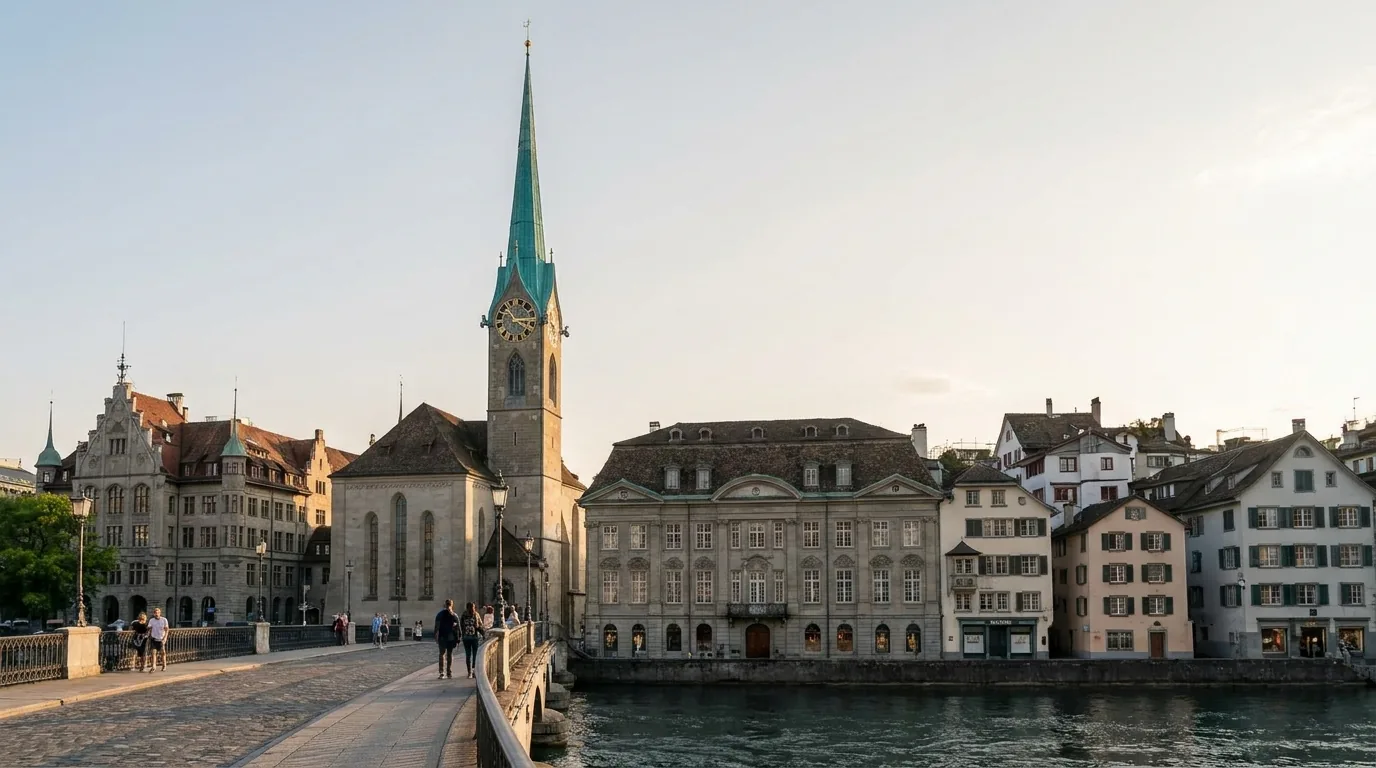
The Fraumünster is the church with the slender green spire on the west bank of the Limmat, facing the Grossmünster across the river, and it holds one of Zürich’s great art treasures: five stained-glass windows by Marc Chagall. Founded as a royal abbey for noblewomen in 853, the Fraumünster church was run by powerful abbesses for almost 700 years, and today you can see the Chagall and Giacometti windows, the crypt museum and the painted cloister in one easy visit. We checked every opening time and price below on the church’s official website and on zuerich.com on 14 November 2026.
| Opening hours, winter | 1 Nov–28 Feb: Mon–Sat 10:00–17:00, Sun 12:00–17:00 (after the 10:00 service) |
|---|---|
| Opening hours, summer | 1 Mar–31 Oct: Mon–Sat 10:00–18:00, Sun 12:00–18:00 |
| Last entry | 15 minutes before closing. Hours can change at short notice for services, funerals and concerts |
| Entry price | CHF 5 for adults; groups of 5 or more CHF 4 each. Free for under-16s, students with ID, KulturLegi holders and anyone coming to pray. Cash, card or Twint, tickets on site only |
| Included | Crypt museum, free audio guide in the “Altstadtkirchen Zürich” app (English, German, Spanish; bring headphones), illustrated leaflet in nine languages, CHF 5 off the Kunsthaus collection |
| Zürich Card | Free entry with the Zürich Card |
| Combo ticket | Fraumünster + Grossmünster Karlsturm tower: adults CHF 8 (instead of CHF 10), children 6–16 and students CHF 2 |
| Address | Münsterhof 2, 8001 Zürich (Old Town, west bank of the Limmat) |
| Tram | Paradeplatz or Helmhaus (trams 4 and 15), both about 2 minutes on foot; about 10 minutes’ walk from Zürich HB |
| Time needed | 30–45 minutes for the church, windows and crypt; add 15 minutes for the cloister |
| Best light | A bright, sunny morning: the choir faces east, so the Chagall windows glow most from opening time to about midday |
| Closed to visitors | Sunday mornings (service at 10:00) and during concerts, funerals and special events; see the November dates below |
A short history of the Fraumünster abbey
According to Zürich’s oldest surviving document, King Louis the German founded a convent here in 853 for his daughter Hildegard. A first church was consecrated on this spot in 874, built as a basilica with three aisles and three apses. Over the next centuries the building kept growing: the south tower probably dates from the first half of the 12th century, the north tower from around 1220–1230.
From about 1250 the choir and transept were rebuilt, begun in Romanesque style and finished in Gothic, which is why you still see both styles today. The nave followed slowly in the 14th and 15th centuries, and in the early 20th century the architect Gustav Gull gave the church its present look.
The old abbey buildings beside the church were pulled down at the end of the 19th century to make room for the Stadthaus, Zürich’s city administration building. What survived is the church itself, the cloister walk next to it and two panelled rooms that are now in the Swiss National Museum (more on both below).
Hildegard, Berta and the powerful abbesses
The Fraumünster was no ordinary convent. Its first abbesses were the king’s daughters Hildegard and Berta, and legend says a stag with glowing antlers showed them where to build, beside the Limmat. In all, 29 abbesses from Europe’s high nobility led the abbey. For centuries they were among the most powerful people in Zürich: the abbess held the right to mint the city’s coins, collect tolls and run the market, and in the Middle Ages she ranked as a princess of the Holy Roman Empire.
The story ends with a remarkable woman. Katharina von Zimmern became abbess in 1496, invited the reformer Huldrych Zwingli to preach in her church, and in 1524 handed the abbey with all its property and rights to the city council. Her decision helped Zürich go through the Reformation without civil war, and the Fraumünster became a Reformed parish church, which it still is today. The city marked the 500th anniversary of her handover in 2024.
The five Chagall windows: what each one shows
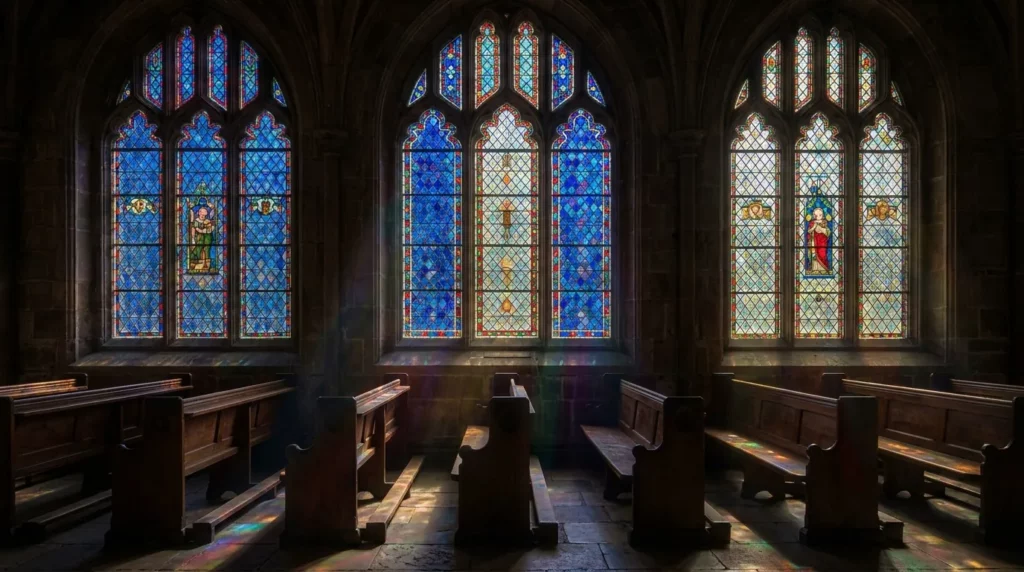
The reason most people come to the Fraumünster is the cycle of five tall, narrow windows in the choir, completed by Marc Chagall in 1970 when he was in his early eighties. Chagall (1887–1985), already famous for his windows in a synagogue in Jerusalem, made them together with the master glass painter Charles Marq in Reims, after the parish priest Peter Vogelsanger and the patrons Lou and Heinrich Hatt-Bucher asked him. Each window has one main colour, and together they tell of creation, calling, hope and salvation. These Chagall windows in Zürich are one of the best-known works of art in the whole country. From left to right:
1. The Prophets window (red, left side of the choir)
Elijah rises to heaven in a fiery chariot pulled by horses, leaving Elisha behind. A cherub hovers in the middle, and above it Jeremiah sits lost in thought in a blue robe. The round arch at the top shows the creation of the world.
2. The Jacob window (blue, front left)
Jacob floats with his hands folded in his lap and his eyes open, dreaming of the ladder to heaven that fills the upper part of the window. Just below it you see Jacob wrestling with the angel.
3. The Christ window (green, centre)
The middle and most famous window tells the life of Christ from birth to resurrection: Joseph, the tree of Jesse, the Lamb of God, Mary and Elizabeth, the life and parables of Jesus and the crucifixion.
4. The Zion window (yellow, front right)
An angel announces the beginning of eternity, and below it the new Jerusalem comes down from heaven. At the bottom are King David, singer of the Psalms, and Bathsheba.
5. The Law window (blue, right side of the choir)
Moses, holding the tablets of the commandments, looks down on the disobedience and suffering of humanity. The middle shows absolute peace, and below it Isaiah, held by an angel, gets ready to bring his message of peace to the world.
The Chagall rose window
Eight years later, in 1978, Chagall added a rose window in the south transept. It shows the stages of Genesis, with Noah’s Ark at the centre as a sign of the rescue of creation.
The Giacometti window and the Heaton west window
Before Chagall there was Augusto Giacometti. His window “Heavenly Paradise” (Das himmlische Paradies) in the north transept dates from 1945 and was his last large work in glass. At about nine metres high, it shows God the Father and Christ with prophets and evangelists, surrounded by angels, in dense, deep colours. It is counted among the major works of 20th-century Swiss stained glass.
At the opposite end of the church, the large west window behind the organ is by the English glass painter Clement Heaton, made in 1914 at the end of the big renovation. Because it is so far from the visitor, Heaton used colour and light rather than detailed scenes, with four angels as the main accents. The organ now covers part of it.
The crypt museum, the founding fresco and St. Mary’s Chapel
Your ticket includes the crypt museum (Krypta Museum) under the church. The remains of the old crypt were found during restoration work in 1900, used as a storeroom for decades, and opened to the public in 2016 after careful renovation. Walls from the early building phases are on show, with drawings and animations that explain how the convent, the church and the Reformation developed over 1,200 years. Look out for the head of a statue of Mary found in recent excavations, a striking reminder of the iconoclasm of the Reformation. The crypt is open during the church’s hours, but it is down a staircase and not wheelchair-accessible.
Upstairs, look for the enlarged copy of the founding fresco painted around 1300 above the tomb of Hildegard and Berta (rediscovered in 1847, the original is largely lost), and for St. Mary’s Chapel (Marienkapelle), with wall paintings from the early 14th century to about 1515, including Hildegard and Berta with the stag of the legend.
The cloister murals by Paul Bodmer
Next to the church, on the side towards the Stadthaus, the old cloister walk (Kreuzgang) survives. Its walls are covered with a cycle of frescoes by the Swiss painter Paul Bodmer, painted in the 1920s and early 1930s. They tell the legend of how the abbey was founded, with Hildegard, Berta and the stag, and the story of Felix and Regula. It is often missed and usually open during the day; ask at the church desk if you can’t find the way in. On 22 November 2026 (Ewigkeitssonntag), the parish holds a public remembrance of the dead in the cloister after the service, from 11:30 to 12:00.
The abbey rooms in the Swiss National Museum
If you want to see how the last abbess lived, walk ten minutes to the Landesmuseum Zürich next to the main station. When the abbey buildings were demolished, the Swiss National Museum saved their finest rooms: two original rooms of Katharina von Zimmern’s residence, her reception room and her private room with late-Gothic carved panelling from 1507/08, plus the panelled parlour of an earlier abbess, Cäcilia von Helfenstein. They are part of the permanent collection in the west wing, where they were restored in 2019. Entry to the museum is a separate ticket (free with the Zürich Card); see the Landesmuseum website for current prices.
Fraumünster opening hours and tickets
The Fraumünster is open all year, with one hour less in the evening in winter:
- Winter (1 November – 28 February): Monday to Saturday 10:00–17:00; Sunday 12:00–17:00
- Summer (1 March – 31 October): Monday to Saturday 10:00–18:00; Sunday 12:00–18:00
- Sundays: the service starts at 10:00 (in German); the church opens to visitors from 12:00
- Last entry: 15 minutes before closing. The church warns that hours can change at short notice
The entry and information fee for tourist visits is CHF 5 (CHF 4 each for groups of five or more). It is free for children and teenagers up to 16, students with a student card, KulturLegi holders and anyone who comes in to pray or sit quietly. Tickets are sold only at the desk by the entrance (cash, card or Twint); there is no online booking. Entry is also free with the Zürich Card, which is worth doing the maths on in our Zürich Card guide.
The fee includes the crypt museum, an illustrated leaflet and the free audio tour in the “Altstadtkirchen Zürich” app (English, German, Spanish). Download it at home or on the church’s free Wi-Fi, and bring headphones; the shop sells them if you forget. Keep your ticket: it gives you CHF 5 off the collection at the Kunsthaus Zürich, which owns a fine group of paintings by Marc Chagall.
The combo ticket with the Grossmünster is still offered: CHF 8 for adults instead of CHF 10, CHF 2 for children aged 6–16 and students. It covers the Fraumünster with its windows and crypt plus the Karlsturm tower climb at the Grossmünster. The tower is currently open only Friday to Sunday, so plan the combo for the weekend. Always check the official Fraumünster visitor page before you go.
Special hours in November and December 2026
Because the Fraumünster is a working church and a popular concert venue, it often closes early. These are the special hours the church has published for the rest of November 2026:
- Sunday 15 November: 12:00–14:00
- Tuesday 17 November: 10:00–16:15
- Wednesday 18 November: closed
- Friday 20 November: 10:00–13:30
- Saturday 21 November: 10:00–14:00
- Tuesday 24 November: 10:00–12:00
- Friday 27 November: 10:00–12:00
- Saturday 28 November: 10:00–14:00
- Sunday 29 November: closed
- Monday 30 November: 10:00–13:00
December dates had not been published yet when we checked. Advent and Christmas are the busiest time for concerts and services, so expect more short days, and check the church’s page in the morning before you set off. For what else is on, see our guides to Christmas in Zürich and the Zürich Christmas markets.
Concerts, organ and services
Music matters here. The Fraumünster had an important organ as early as the 15th century; it disappeared after the Reformation, and the present main organ was installed in 1953, inaugurated by the French organist Marcel Dupré on 4 October that year. Since 1999 the choir organ can be coupled to it electrically, which gives the church an unusually rich sound. The Fraumünster choir has sung here since 1871.
There are concerts most weeks, from big choral works to short organ sessions. Coming up in November 2026, for example: Carl Orff’s Carmina Burana with the Ensemble Sinfonietta Bern on Saturday 14 November at 19:15; “Werkstatt für Wort und Musik” on Tuesday 17 November at 18:15; and “Orgelmusik am Morgen”, fifteen minutes of organ music with a thought and a blessing, on Wednesday 18 November at 07:45. Programmes and tickets are in the parish’s events calendar. For more concert halls, see our Tonhalle guide and our list of theatres, concert halls and stages in Zürich.
The Sunday service is at 10:00, in German, and everyone is welcome. Public guided tours are in German too, for example “Auf den Spuren von Marc Chagall” with the Kunsthaus on Thursday 26 November at 14:00 (90 minutes, church and Kunsthaus). Private tours in English can be booked on the tours page.
Visitor rules, photos and accessibility
- Photos: allowed for private use, without flash or tripod and not during services. The Chagall windows are protected by copyright, so no professional or commercial shoots, private photo sessions or long group selfie sessions.
- Behaviour: keep your voice down; no eating or drinking inside; no sitting on the floor or the choir steps.
- Bags: large suitcases, backpacks and trolleys are not allowed inside. Prams and buggies can be left with the staff at the desk.
- Dogs: not allowed, except assistance dogs.
- Accessibility: the entrance, nave, shop and exit are step-free and there is an accessible toilet to the right of the main entrance. A few steps with a handrail lead up to the choir with the Chagall windows, and the crypt is not wheelchair-accessible. There is a hearing loop, and audio guides with an alternative keypad for visitors with low vision.
- Shop: the small shop in the transept sells products with the Chagall window motifs that you can only buy here.
How to get to the Fraumünster
The Fraumünster stands on the Münsterhof, Münsterhof 2, 8001 Zürich, on the west bank of the Limmat, a short block from Bahnhofstrasse. The two closest stops are Paradeplatz, served by many tram lines, and Helmhaus (trams 4 and 15) just across the Münsterbrücke; from either it’s about two minutes on foot. From Zürich HB it’s about 900 metres, a ten-minute walk along Bahnhofstrasse. Several tram lines run on changed routes until the timetable change on 13 December 2026, so check zvv.ch before you go, and see our guide to getting around Zürich for tickets and zones.
Don’t drive: cars may only enter the lanes around the church between 5:00 and 12:00, parking needs a permit, and the nearest public spaces are blue-zone spots by the Stadthaus.
What’s nearby: Münsterhof, Paradeplatz, St. Peter and the Grossmünster
Münsterhof. The square in front of the church is one of the most beautiful in the city, car-free and lined with old guild houses. Walk a few steps to the Münsterbrücke for the classic view of both minsters.
Paradeplatz and Bahnhofstrasse. Two minutes west is Paradeplatz, home of the big Swiss banks and the famous Sprüngli café, at the heart of Bahnhofstrasse, Zürich’s shopping street.
St. Peter. Three minutes north, up the lane from the Münsterhof, St. Peter has the largest church clock face in Europe and free entry. Keep climbing to the Lindenhof for the best free view over the Old Town.
Grossmünster. Cross the Münsterbrücke and you’re at the twin-towered Grossmünster, Zwingli’s church, with Giacometti and Sigmar Polke windows and the Karlsturm tower. Our Zürich Old Town walking route links all of these in one loop, and the Fraumünster is a perfect stop on a cold or rainy day in Zürich.
Fraumünster church: frequently asked questions
How much does it cost to visit the Fraumünster?
CHF 5 for adults, including the crypt museum and the app audio guide. It’s free for under-16s, students with ID, KulturLegi holders, Zürich Card holders and anyone coming to pray. The combo ticket with the Grossmünster tower costs CHF 8.
Can I take photos of the Chagall windows?
Yes, for private use, without flash or tripod and not during services. Professional and commercial photos are not allowed because the windows are under copyright.
When is the best time to see the Chagall windows?
On a sunny morning, from 10:00 to about midday, when the light comes through the east-facing choir.
Is the Fraumünster open on Sundays?
Yes, but only from 12:00, after the 10:00 service, until 17:00 in winter and 18:00 in summer. Some Sundays it closes early or stays closed for events, such as 29 November 2026.
What’s the difference between the Fraumünster and the Grossmünster?
They face each other across the Limmat. The Fraumünster, a former abbey for noblewomen with a single slender spire, is famous for its Chagall windows. The twin-towered Grossmünster is linked to Zwingli and the Reformation and has a tower you can climb. Seeing both takes about two hours.
Keep planning
- Things to do in Zürich: the ultimate guide
- Things to do in Zürich in winter
- Best museums in Zürich
- Free things to do in Zürich
- Best brunch in Zürich
- Where to stay in Zürich
- All Zürich places
📬 The ZurichGuru newsletter
Once a week: the best events, new places and what is changing in Zürich. Free, unsubscribe any time.