'/%3E%3C/svg%3E) EN
 DE

Moving to Zürich is exciting, and for the first few weeks it is also a paperwork project. The good news: the Swiss system is clear, the deadlines are fixed and the offices are efficient, so if you do things in the right order you can be settled within a month. This is our complete newcomer’s guide, with every step checked on the official city, canton and federal websites in November 2026: permits, registering, finding a flat, health insurance, bank, AHV number, taxes, phone, transport, schools, real costs in CHF, the twelve Kreise, and a first-week checklist.
Moving to Zürich at a glance: the deadlines that matter
Most of moving to Zürich is flexible. These few dates are not, so put them in your calendar the day you arrive.
| What | Deadline | Where |
|---|---|---|
| Register your arrival (residence permit) | Within 14 days of moving in | Personenmeldeamt, by appointment |
| Basic health insurance | Within 3 months of arrival (backdated) | Any Swiss health insurer |
| Children: kindergarten and school | As soon as you have an address | Your Kreisschulbehörde |
| Swap your foreign driving licence | Within 12 months | Strassenverkehrsamt Zürich |
| Register a dog | Within 10 days | City dog office + AMICUS |
| Apply for an ordinary tax assessment (if you want one) | 31 March of the following year | Kantonales Steueramt |
Residence permits: L, B, C and G explained
Anyone staying in Switzerland for more than three months needs a permit, and what you get depends mainly on your passport and your work contract. The canton’s Migrationsamt issues the permit; you start the process when you register in the city (see the next section).
EU and EFTA citizens
Thanks to the free movement agreement, citizens of the EU and EFTA can live and work in Zürich without a quota. The permit simply follows your job:
- L permit (short-term): for a work contract of 3 to 12 months. It runs as long as the contract and can be extended to a total of less than 12 months. Jobs under three months only need an online notification, no permit (SEM: L permit).
- B permit (residence): for a contract of 12 months or more, or an open-ended one. It is valid for five years and can be renewed for another five (SEM: B permit).
- C permit (settlement): unlimited, with the same rights as Swiss citizens on the job market. Citizens of Germany, Austria, France, Italy, Spain, Portugal, the Netherlands, Belgium, Luxembourg, Denmark, Finland, Sweden, Greece, Ireland and the EFTA states get it after five years; other EU citizens after ten (SEM: C permit).
- G permit (cross-border commuter): you live abroad, work in Switzerland and go home at least once a week (SEM: G permit).
Non-EU citizens (including the UK)
For everyone else, the employer applies for the work permit before you move, and the rules are strict: Switzerland only admits qualified people such as managers and specialists, usually with a degree and several years of experience (SEM: non-EU workers). Permits are also capped by yearly quotas. For 2026 the Federal Council kept 8,500 permits for third-country nationals (4,500 B and 4,000 L) and a separate 3,500 for UK citizens (2,100 B and 1,400 L). Since 2021, British citizens count as third-country nationals unless they already lived here before the end of 2020 (SEM: Brexit). Non-EU B permits are temporary and are renewed by the canton; in the canton of Zürich the C permit usually comes after ten years, the last five without a break on a B permit, plus German at level A2 spoken and A1 written (zh.ch: C permit).
Renewal tip: you can apply to renew a permit at the earliest three months and at the latest two weeks before it expires (ch.ch).
After ten years and with a C permit you can apply to become Swiss: the steps, test and fees are in our guide to Swiss citizenship in Zürich.
Registering in Zürich within 14 days
This is the one deadline you really cannot miss when moving to Zürich. Within 14 days of moving in, you must report your arrival to the city’s Personenmeldeamt (residents’ registration office). You may still hear the old name “Kreisbüro”; today, everyone arriving from abroad registers in person at the Personenmeldeamt Zürich Süd in the Stadthaus, Monday to Friday 08:00 to 16:30, by appointment only. Book your slot online at stadt-zuerich.ch/registration-pma. If the first free slot falls after the 14 days, book it anyway and ask for an extension through the city’s contact form.
You can only register once you have actually moved in, and every family member must come along. Bring (official list):
- Passport (EU/EFTA citizens can also use their ID card).
- Rental contract, sublet contract, proof of ownership or a move-in confirmation (Einzugsanzeige).
- Your employment contract or proof of study.
- Any permit assurance or visa you received in advance.
- Original marriage certificate if you move as a couple, and original birth certificates for children. Documents not in German, French, Italian or English need an official translation.
- If only one parent moves with a child: written consent and an ID copy of the other parent.
The registration fee is CHF 40 per adult, plus the canton’s permit fee, which depends on your nationality and permit type. Card payment is preferred. If you live with your landlord or a host, they must also confirm your move-in online. Your permit card is sent to you by post afterwards.
The three offices, opening hours and every later service (moves, certificates, leaving) are in our guide to the Kreisbüro Zürich.
Finding a flat in Zürich
This is the hard part. On 1 June 2026 only 0.11% of flats in the city were empty, against 0.52% in the canton (zh.ch, August 2026). Good flats get dozens of applications, so speed and a complete dossier win.
Where to search
- Homegate, ImmoScout24 and Flatfox are the big three; set up instant alerts for your price and Kreise.
- Many people start in a furnished or temporary flat for one to three months and look for a permanent home once they are here.
- Cooperatives (Genossenschaften) and the city’s own housing are much cheaper, but waiting lists are long; register as early as you can.
Your application dossier
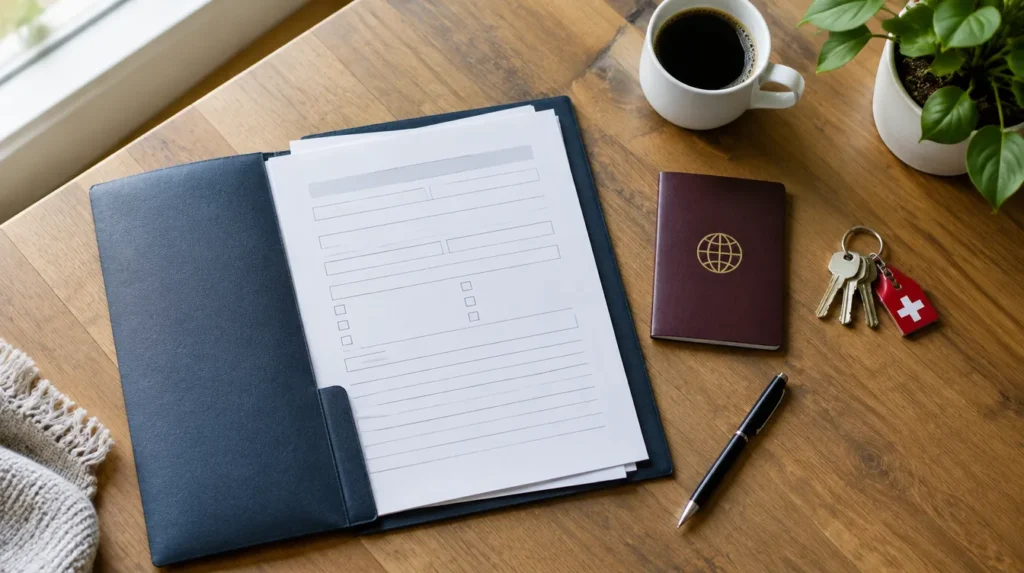
Landlords and agencies expect a short, complete file the moment you leave the viewing. Have it ready as one PDF:
- Filled-in application form (each agency has its own).
- Copy of passport and permit (or the registration confirmation while the permit is on its way).
- Employment contract or your last three payslips.
- Betreibungsauszug (debt-collection register extract), not older than three months.
- A short, friendly cover letter about who you are and why you want the flat.
The Betreibungsauszug shows that nobody is chasing you for unpaid bills. In the city you order it online, by post or at the counter of your Kreis’s Betreibungsamt; the standard extract costs CHF 17 plus postage (stadt-zuerich.ch, ch.ch). It only covers your Swiss addresses, so right after arrival it will simply be clean; order it as soon as you are registered.
Deposit, rent and moving in
For a flat, the landlord may ask for a deposit of at most three months’ rent (ch.ch). By law it goes into a rent-deposit account in your name at a Swiss bank (Code of Obligations, art. 257e), not into the landlord’s pocket. If you cannot put up that much cash, rent-deposit insurers offer a guarantee for a yearly fee instead.
Rents are usually quoted “netto” plus a monthly charge for heating and service costs (“Nebenkosten”). At move-in, the landlord walks through the flat with you and writes a handover report (Übergabeprotokoll): note every scratch, because the same check happens when you leave, and Swiss flats are handed back professionally clean. Need help with the move itself? Our removal companies in Zürich and cleaning companies lists are a good start, and Find a Pro covers electricians, plumbers, painters and more.
Health insurance: compulsory within three months
Basic health insurance (Grundversicherung) is compulsory for everyone who lives in Switzerland, whatever their nationality. You have three months from your arrival to sign up, and the cover is backdated to the day you arrived, so you pay premiums from day one anyway. Sign up late and the cover only starts on the day you join, plus a premium surcharge (FOPH).
Basic cover is identical by law at every insurer; only price and service differ. Compare all offers on the federal premium calculator priminfo.admin.ch.
Franchise and retention: how much you pay yourself
- Franchise (deductible): the first part of your yearly medical bills, which you pay yourself. For adults it ranges from CHF 300 (standard) to CHF 2,500; a higher franchise means a lower premium. The standard franchise for children is CHF 0 (FOPH: deductibles).
- Retention (Selbstbehalt): on top of the franchise you pay 10% of the bills, capped at CHF 700 a year for adults and CHF 350 for children (FOPH: co-payment).
Rule of thumb: rarely ill? A CHF 2,500 franchise saves the most. Regular doctor visits or medication? Stay at CHF 300.
Insurance models
Besides the standard model (free choice of doctor), insurers offer cheaper models where you agree to call a fixed first contact before seeing a specialist: your family doctor or an HMO practice, a telemedicine hotline or app, or a partner pharmacy (FOPH: insurance models). For most healthy newcomers, a family-doctor or telmed model with a high franchise is the cheapest option.
What it costs, and help with premiums
For 2027 the average premium in the canton of Zürich rises 5.8% to CHF 404.40 a month (all ages). The Swiss average for an adult is CHF 487.60 (FOPH, September 2026). On a lower income you can apply for a premium reduction (IPV) with SVA Zürich; if granted, it is deducted directly from your insurer’s bills. Dental care is not part of basic cover, and supplementary insurance is optional.
Opening a Swiss bank account
You will need a Swiss account for your salary, your rent and your rent deposit. The big options are the cantonal bank (Zürcher Kantonalbank), UBS, PostFinance, regional banks and app-based banks. Most ask for your passport, your permit or registration confirmation, and your Swiss address, so the easiest order is: register first, then open the account. Your employer can usually pay your first salary as soon as you give them the IBAN. Also get a debit card that works with TWINT, the Swiss payment app that you will use for everything from parking to splitting a dinner bill.
Your AHV number and social security
Everyone who lives or works in Switzerland gets an AHV number (AVS in French, OASI in English): 13 digits starting with 756. It is your social security number for the state pension, disability insurance and more, and it is printed on your health insurance card. Your employer registers you and deducts the contributions from your salary; if you need the number earlier, ask your employer (ch.ch: AHV number, AHV/IV: salary contributions).
Where to find your number, what to do if you lose it and how to check your contribution account: see our guide to the AHV number.
Taxes: Quellensteuer explained
If you work in Zürich without a C permit or a Swiss passport, you pay tax at source (Quellensteuer): your employer deducts it from every payslip and pays it to the canton. You do not file a normal tax return unless one of these applies (zh.ch: who pays withholding tax):
- Gross salary of CHF 120,000 a year or more: an ordinary assessment (nachträgliche ordentliche Veranlagung, NOV) is compulsory. You then file a full return every year and the tax already withheld is credited.
- Below CHF 120,000: you can apply for an ordinary assessment or a correction, for example to deduct pillar 3a payments, childcare or commuting costs. The deadline is 31 March of the following year, online only, with no extension (zh.ch: NOV).
- If you are married to a Swiss citizen or a C-permit holder, you are taxed normally and file a return.
Once you receive a C permit, you switch to the normal system with a yearly tax return.
Mobile phone, internet and the media fee
The three networks are Swisscom, Sunrise and Salt, plus cheaper brands that use their networks. A prepaid SIM bought with your passport gets you online on day one; switch to a subscription once you have a Swiss address and bank account. Home internet (fibre is common in the city) can take a while to switch on, so order it as soon as you sign the lease.
One Swiss extra: every household pays the radio and TV fee to SERAFE, whether you own a TV or not. It is CHF 335 a year in 2026 and is set to drop to CHF 312 in 2027. The invoice arrives automatically after you register.
The fee amount, exemptions and fake invoices are covered in detail in our Serafe guide.
Getting around: ZVV passes and the Halbtax
You do not need a car in Zürich. Trams, buses, S-Bahn trains and even lake boats are all part of the ZVV network. The city is zone 110, which counts as two zones, so the pass you need is “1–2 zones”:
| ZVV NetzPass, adult, 2nd class, city (2 zones) | Until 12 Dec 2026 | From 13 Dec 2026 |
|---|---|---|
| Monthly pass (personal) | CHF 88 | CHF 91 |
| Yearly pass (personal) | CHF 813 | CHF 840 |
| Yearly pass, ages 16–24 | – | CHF 609 |
| Single ticket / 24-hour ticket, 1–2 zones | – | CHF 4.80 / CHF 9.60 |
Prices from zvv.ch and the ZVV price list from 13 December 2026. For trips around Switzerland, get the SBB Half Fare travelcard (Halbtax): CHF 190 for the first year (age 25+) and half price on almost all trains, buses and boats; new national fares apply from 13 December 2026. Read our full guide to getting around Zürich, and check the live tram and train departures.
Prices and break-even examples for both cards are in our guide to the Half Fare travelcard and GA.
Schools and childcare
State schools in Zürich are free and open to every child living in the canton (zh.ch: Volksschule). The key facts:
- Kindergarten is compulsory and lasts two years. A child who turns four by 31 July starts in mid-August of that year (zh.ch: kindergarten).
- The city has seven school districts (Schulkreise). Your address decides the school, and you register your child, for kindergarten, school and after-school care, with the Kreisschulbehörde of your district (stadt-zuerich.ch: school start). Children who do not speak German get extra German lessons.
- Private and international schools exist too, all approved by the canton (zh.ch: private schools); fees are high and places for popular year groups go early.
- Daycare (Kita): if you live in the city and your income is low to middle, a place in a Kita with a city contract is subsidised. Parents then pay between CHF 12 and CHF 120 a day (stadt-zuerich.ch: Kita costs). Put your name down early; popular Kitas have waiting lists.
Cost of living in Zürich in CHF
Zürich regularly ranks among the most expensive cities in the world, and rent plus health insurance are the two biggest monthly costs. Salaries are high to match, but plan for a heavy first two months, when the deposit, furniture and setup costs all land at once. Official figures for 2026:
| Cost | Typical amount |
|---|---|
| Rent, 3-room flat (median, all existing leases) | CHF 1,628 a month |
| Rent, 75 m² flat newly let in an existing building | about CHF 2,290 a month (CHF 30.50/m²) |
| Rent, 75 m² flat in a new building | about CHF 2,910 a month (CHF 38.80/m²) |
| Rent deposit | up to 3 months’ rent, once |
| Health insurance, average premium canton Zürich (2027) | CHF 404.40 a month per person |
| ZVV city pass | CHF 88 a month (CHF 91 from 13 Dec 2026) |
| SERAFE media fee | CHF 335 a year per household |
| Züri-Sack rubbish bags, 35 litres, roll of 10 | about CHF 15.45–19.95 |
Rent figures: Statistik Stadt Zürich, Mietpreise 2026. Note the gap: the median includes long-running leases and cheap cooperative flats, while a newcomer usually signs a new lease at today’s market price. Our CHF to EUR converter helps when you compare with home, and our guide to free and cheap things to do in Zürich keeps the weekends affordable.
Zürich’s 12 Kreise at a glance
The city is divided into twelve districts, the Kreise. Where you live shapes your daily life more than anything else, so spend a weekend walking around before you sign.
| Kreis | Areas | What it’s like |
|---|---|---|
| Kreis 1 | Altstadt, City, Lindenhof | The historic centre: beautiful, central, few and pricey flats. |
| Kreis 2 | Enge, Wollishofen, Leimbach | Lakeside, calm and green, popular with families and finance staff. |
| Kreis 3 | Wiedikon, Sihlfeld, Friesenberg | Lively and down to earth, good cafés, close to the Uetliberg. |
| Kreis 4 | Aussersihl, Langstrasse, Hard | Colourful, multicultural, the city’s nightlife hub. Can be loud. |
| Kreis 5 | Gewerbeschule, Escher Wyss (Zürich-West) | Former industrial area: lofts, Viadukt, Frau Gerolds Garten, bars. |
| Kreis 6 | Unterstrass, Oberstrass | Leafy and residential near the university, loved by families and students. |
| Kreis 7 | Fluntern, Hottingen, Hirslanden, Witikon | The green hillside by the Zürichberg forest: quiet, upmarket. |
| Kreis 8 | Riesbach, Seefeld | Upscale lakeside living, boutiques, the lake promenade on your doorstep. |
| Kreis 9 | Altstetten, Albisrieden | Big, residential and better value, fast trains from Altstetten station. |
| Kreis 10 | Wipkingen, Höngg | By the Limmat river, village feel in Höngg, swimming in summer. |
| Kreis 11 | Oerlikon, Seebach, Affoltern | Zürich-Nord: modern, well connected, among the more affordable areas. |
| Kreis 12 | Schwamendingen | Quiet and green, more affordable, with a new park over the motorway. |
Want to get to know your new neighbourhood? Browse our best places in Zürich and the top things to do in Zürich.
Everyday life: rules worth knowing
- Rubbish: household waste only goes out in the official blue Züri-Sack bags, sold at supermarkets. Glass, PET, paper, cardboard and metal are recycled separately, and bulky items go to the recycling centres Werdhölzli and Looächer (stadt-zuerich.ch: Züri-Sack).
- Quiet hours: night rest is from 22:00 to 07:00 (23:00 on Friday and Saturday nights in summer), plus lunchtime 12:00 to 13:00 on weekdays and all day on Sundays and public holidays (stadt-zuerich.ch: everyday noise). No drilling or recycling glass on a Sunday.
- Sundays and holidays: most shops are closed on Sundays. See which shops are open on Sunday in Zürich and the dates of all Zürich public holidays.
- Driving licence: a foreign licence must be exchanged for a Swiss one within 12 months of arrival, otherwise you may not drive. It costs about CHF 70, and a control drive may be ordered (zh.ch: licence exchange).
- Dogs: register your dog with the city and with AMICUS within 10 days (stadt-zuerich.ch: dogs).
- Liability insurance: private liability insurance is not compulsory in general, but it is cheap and worth having, because damage in a rented flat is the classic case it covers (ch.ch).
- When you’re ill at night: find the emergency pharmacy in Zürich that is open right now.
- Language: the official language is German and people speak Swiss German, but English works at most offices and workplaces. A German course pays off socially and is needed later for the C permit.
Your first-week checklist
- Book your Personenmeldeamt appointment online (ideally before you arrive) and register within 14 days.
- Get a prepaid SIM so you have a Swiss number for flat viewings and banks.
- Open a Swiss bank account and give the IBAN to your employer.
- Compare health insurers on priminfo.admin.ch and sign up (deadline: 3 months).
- Buy a ZVV monthly pass and consider the Halbtax.
- Order your Betreibungsauszug and build your flat application dossier.
- Register your children with your Kreisschulbehörde and put your name down for a Kita.
- Order home internet as soon as you have a lease.
- Buy Züri-Sack bags and learn your recycling days.
- Put the 12-month driving licence deadline in your calendar.
Settling in? Find a Pro also lists a handyman in Zürich for shelves and lamps, plumbers and electricians by area, and movers outside the city, for example in Winterthur and Dübendorf.
Sign up with a family doctor in Zürich and find dentists near your new home early. Moving west of the city? There are also movers in Dietikon.
Driving here? You have 12 months to exchange your driving licence in Zürich.
Step-by-step guides for newcomers
- Registration and residence permit in Zürich
- Opening a bank account in Zürich
- Taxes in Zürich: withholding tax and tax return
- Schools in Zürich: public and international
- Childcare in Zürich: Kitas, costs and subsidies
- Zürich neighbourhoods: where to live
- Kreisbüro Zürich (Personenmeldeamt): offices, hours and services
- AHV number: how to get it and where to find it
- Serafe: the radio and TV fee explained
- Half Fare travelcard and GA: which one pays off
- Exchanging your driving licence in Zürich
- Swiss citizenship in Zürich: rules, test and fees
More guides for your first months in Zürich
- Health insurance in Zürich: rules, models and costs
- Recycling in Zürich: Züri-Sack and collection days
- Swiss German phrases for newcomers
- Zürich Card: is it worth it?
- Zürich month by month
Many newcomers start in a flatshare; our WG Zimmer Zürich guide explains where to search, what to write and how to avoid fake ads.
For renewals, family reunification and the return visa later on, keep our guide to the Migrationsamt Zürich at hand.
With a B or L permit your employer deducts tax from every payslip; our withholding tax guide shows how to check the rate and when a tax return pays off.
Learning the language early helps a lot: compare 13 German courses in Zürich, from city-supported to private.
Moving with children and want English-language teaching? Compare 16 international schools in Zürich with CHF fees.
Moving with children? The Swiss school system guide shows how kindergarten, Sekundarschule, Gymnasium and apprenticeship fit together.
FAQ about moving to Zürich
How soon do I have to register after moving to Zürich?
Within 14 days of moving in, in person and by appointment at the Personenmeldeamt Zürich Süd. If no slot is free in time, book the next one and request an extension via the city’s contact form.
Can I register before I have a permanent flat?
Yes, as long as you actually live at the address: a sublet contract or a move-in confirmation from your host also counts. Registering at an address where you don’t actually live is not possible.
Is health insurance really compulsory if I’m only here for a year?
Yes. Anyone who takes up residence in Switzerland must insure within three months, and the cover is backdated to the day of arrival.
How much rent should I expect?
The median 3-room flat in the city costs CHF 1,628 a month, but that includes old leases. For a newly let 75 m² flat, budget roughly CHF 2,300 to 2,900 a month.
Are state schools free, and do they teach in English?
State schools are free and teach in German. Children who don’t speak German get extra German lessons; English-language teaching is only available at private international schools.
Do I need to file a tax return on a B permit?
Usually not: tax is deducted from your salary. A return is compulsory from CHF 120,000 gross a year, and below that you can apply for one by 31 March of the following year.
This guide is general information to help you plan, not legal or financial advice. Rules, fees and deadlines change, so always confirm the details for your situation with the official offices linked above. Last checked: November 2026.
Have a question we didn’t answer? Ask ZurichGuru, our free Zürich assistant.
📬 The ZurichGuru newsletter
Once a week: the best events, new places and what is changing in Zürich. Free, unsubscribe any time.