'/%3E%3C/svg%3E) EN
 DE
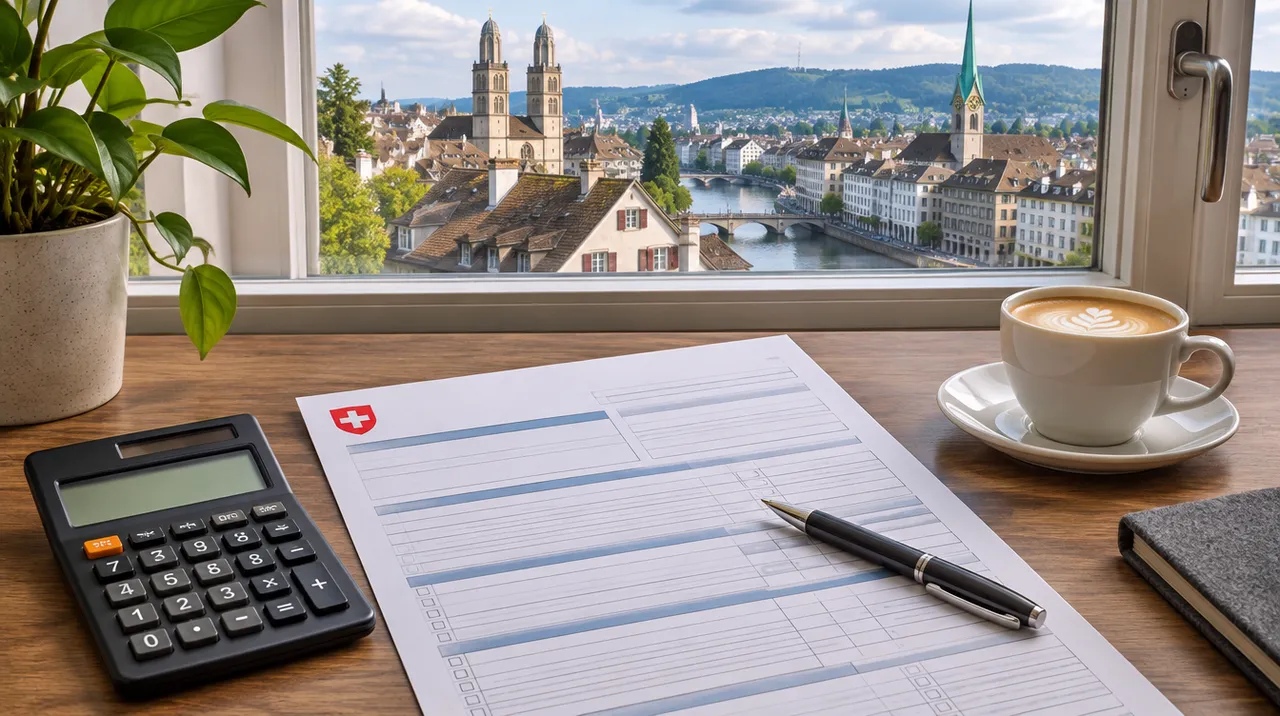
Taxes in Zürich work differently from most countries: you pay three income taxes at once (federal, cantonal and city), and many foreign workers have tax taken straight from their salary instead of filing a return. Which system applies to you depends on your permit, your marital status and how much you earn. Deadlines are strict, and some choices cannot be undone. Below are the eleven steps newcomers need, with the 2026 rates and deductions checked on the official cantonal and city sites in November 2026. For the bigger picture of your first months, start with our guide to moving to Zürich.
📍 City of Zürich 2026: canton 95% + city 119% + church 10% (if a member) · 📅 tax return due 31 March, extension possible · 💰 provisional tax due 30 September · 🧮 official tax calculator (Kanton Zürich)
How taxes in Zürich work
Switzerland taxes income where you live on 31 December. If you live in the city of Zürich, your income is taxed by the Confederation (direct federal tax), the canton of Zürich and the city, and church members also pay church tax. The canton and city share one tax return, and the federal tax is assessed with it.
There are two ways to pay. People with a C permit or Swiss passport, and people married to one, file a yearly tax return. Most other foreign employees pay withholding tax (Quellensteuer): the employer deducts it from every payslip. Your tax ID is your 13-digit AHV number, which you receive when you start work. This guide explains the rules; it is not personal tax advice, and the tax office has the final word on your case.
1. Understand the three levels and the Steuerfuss — how the bill is built
📊 canton 95% (2026 and 2027) · 🏙️ city of Zürich 119% (2026) · ⛪ reformed and Roman Catholic 10%, Christ Catholic 14% · 🇨🇭 federal tax separate, progressive · official rates (City of Zürich)
The canton first calculates a “simple tax” (einfache Staatssteuer) from its progressive tariff. That amount is then multiplied by each Steuerfuss. In the city of Zürich in 2026 that means 95% for the canton plus 119% for the city, so 214% of the simple tax, or 224% if you belong to the reformed or Roman Catholic church. The direct federal tax is calculated on top, with its own progressive scale and a top rate of 11.5%.
The canton cut its rate from 98% to 95% from 2026, and the cantonal parliament fixed 95% for 2027 as well. The city’s 2027 rate is set with the city budget in December 2026; it has been 119% since 2022. Every municipality in the canton has its own rate, which is one reason people compare the Zürich neighbourhoods with towns outside the city before they sign a lease.
2. Check whether you are taxed at source — Quellensteuer
👤 foreign employees without a C permit · 💍 not married to a Swiss citizen or C-permit holder · 🧾 deducted by the employer every month · 🔤 tariffs A, B, C, H (Y/N = with or without church tax) · 2026 tariffs (Kanton Zürich)
If you live in the canton, work for a Swiss employer and have a B or L permit, you are usually taxed at source. The employer deducts the tax from your gross salary and pays it to the canton. The rate already includes the federal, cantonal, city and (if you are a member) church tax.
Check the tariff code on your payslip, for example A0N or C1Y. Tariff A is for single people, B for married sole earners, C for married couples where both earn, and H for single parents. The number is your children, and Y or N says whether church tax is included. A wrong code means a wrong deduction, so tell your employer at once when you marry, have a child or change religion. Withholding tax ends from the month after you get a C permit or marry a Swiss citizen or C-permit holder; from then on you file a normal return.
3. Check the CHF 120,000 rule — when a return becomes compulsory
💰 gross salary of CHF 120,000 or more a year · ➕ or other untaxed income of CHF 3,000+ · 🏦 or worldwide wealth of CHF 80,000+ (CHF 160,000 for married couples) · 📅 you must apply by 31 March of the following year · official rules (Kanton Zürich)
If you are taxed at source and earn at least CHF 120,000 gross a year, you must file a tax return anyway. This is called the subsequent ordinary assessment (nachträgliche ordentliche Veranlagung, NOV). The salaries of spouses are not added together to reach the threshold.
The same applies if you have other income that was not taxed at source of at least CHF 3,000 (rental income, for example), or worldwide wealth of at least CHF 80,000, or CHF 160,000 for married couples. Savings and investments abroad count. The tax office then calculates your real tax and credits the withholding tax already paid. From that year on you receive a tax return every year.
4. Decide on a voluntary tax return by 31 March — once chosen, it stays
📅 deadline 31 March of the following year, cannot be extended · 💻 apply online via ZHservices with your AHV number · 🔒 cannot be withdrawn once filed · 🔁 you then file every year · apply for an NOV (Kanton Zürich)
Below CHF 120,000 you can ask for an ordinary assessment voluntarily. Withholding tariffs only include standard deductions, so a full return can lower your tax if you have high real costs: Pillar 3a payments, buy-ins to your pension fund, childcare, alimony, debt interest or training costs (up to CHF 12,000 a year).
Think before you apply. The canton states that a request filed correctly and on time cannot be withdrawn, and you will receive a tax return every year after that. If your deductions are small, the result can also be a higher bill. For tax year 2026 the deadline is 31 March 2027, and it cannot be extended. If you only want to correct an error (wrong tariff, wrong children count), ask for a Quellensteuer correction instead, with the same deadline.
5. File the ordinary tax return — deadline 31 March
📅 tax return 2025 was due 31 March 2026; tax return 2026 is due in 2027, usually 31 March · ⏳ extension online, then up to 30 November · 💻 online filing with no signature · ⚠️ fines up to CHF 1,000, or CHF 10,000 in serious cases · online tax return (Kanton Zürich)
If you file a return (C permit, Swiss spouse, or NOV), the forms arrive early in the year with an access code. The return covers the previous calendar year: for the 2025 return the canton set 31 March 2026. The 2026 return follows in 2027; check the date on your letter. You can file completely online, upload attachments and skip the signature.
In the city of Zürich you can extend the deadline online by scanning the “E-Frist” QR code on your tax forms, or in your “Steuern verwalten” account. A second request before the extended date can move it to 30 November. Later requests are only accepted for serious reasons such as illness. If you miss the deadlines after a reminder, the tax office estimates your income, and it is hard to challenge that estimate. The city’s extension page has the details.

6. Know the main 2026 deductions — canton and federal differ
🧾 figures for tax year 2026 (return filed in 2027) · 📘 source: cantonal tax guide 2026 · ⚖️ the canton adjusted many deductions for inflation on 1 January 2026 · Wegleitung 2026 (PDF)
Deductions only matter if you file a return (ordinary taxpayers and NOV). The most important ones for employees, with the 2026 limits:
| Deduction (2026) | Canton and city | Federal tax |
|---|---|---|
| Commuting costs (max) | CHF 5,200 | CHF 3,300 |
| Meals away from home (canteen / restaurant) | CHF 7.50 / CHF 15 a day, max CHF 1,600 / 3,200 | same |
| Other job costs (flat rate) | 3% of net salary, min CHF 2,000, max CHF 4,000 | same |
| Pillar 3a (with a pension fund) | CHF 7,258 | CHF 7,258 |
| Insurance premiums and savings interest | CHF 2,900 single / CHF 5,800 married, + CHF 1,300 per child | CHF 1,800 single / CHF 3,700 married |
| Childcare by third parties (per child under 14) | CHF 25,300 | CHF 25,800 |
| Child deduction (per child) | CHF 9,400 | CHF 6,800 |
| Both spouses working (max) | CHF 6,200 | own rules |
| Training and further education (max) | CHF 12,000 | see guide |
The insurance deduction is higher (by half) if you pay neither into a pension fund nor Pillar 3a. Health insurance premiums fall under this cap, and they are usually larger than the cap on their own; our guide to health insurance in Zürich explains the premiums. Families should read the childcare figures together with our childcare in Zürich guide, because Kita fees are one of the largest deductions a household can claim. The commuting deduction covers your ZVV pass too; our guide to getting around Zürich explains zones and passes.
7. Open a Pillar 3a account — the classic tax saver
💰 max CHF 7,258 in 2026 with a pension fund · 💼 20% of earned income, max CHF 36,288, without one · 🆕 from 2026 you can also fill gaps from 2025 onwards · 📅 money must arrive by 31 December · rules in the Wegleitung 2026 (PDF)
Pillar 3a is a tied private pension account at a bank or insurer. What you pay in during the year is deducted from your taxable income, as long as you work and pay AHV contributions. Both spouses can each pay in the maximum if both work. The money is locked until retirement, with exceptions such as buying your own home, leaving Switzerland for good or becoming self-employed.
New since tax year 2026: you can make extra “buy-in” payments for years in which you did not pay the full amount, but only for gaps from 1 January 2025 onwards, only after paying the full amount for the current year, and at most CHF 7,258 per buy-in. Whether 3a makes sense for you depends on your income and plans; a bank or independent adviser can model it. Many banks and apps offer 3a accounts, see our guide to opening a bank account in Zürich.
8. Decide about church tax — it depends on what you declare
⛪ city of Zürich 2026: reformed 10%, Roman Catholic 10%, Christ Catholic 14% of the simple tax · 📝 your religion is recorded when you register · 🔤 Y/N in your Quellensteuer tariff · tariffs with and without church tax
Only members of the three recognised churches (reformed, Roman Catholic, Christ Catholic) pay church tax. When you register at the city’s residents’ office, you are asked your religion, and that entry decides whether church tax is charged, both on a tax return and in your withholding tariff.
If you were baptised but do not want to belong to a Swiss parish, say so at registration. Leaving a church later is done in writing with the church itself, and church tax stops from then on. Check your payslip after registration: Y means church tax is included, N means it is not.
9. Pay by 30 September — interest works both ways
📅 provisional bill in the first quarter · 💰 tax due 30 September of the tax year · 📈 2026: 0.75% interest in your favour or against you · ⚠️ late payment of final bills: 4.5% · provisional bill and interest (City of Zürich)
If you file a return, the city tax office sends a provisional bill for the current year, usually in the first quarter or after you move in. It is an estimate based on your last known income. Payments made before 30 September earn 0.75% interest (2026 rate), and any amount still missing after 30 September is charged at the same rate until the final bill arrives.
You can pay in one go, in instalments with the blank QR slip, or by standing order in e-banking. Once the final bill arrives, you have 30 days; after that, late interest of 4.5% applies. The federal tax is billed separately by the canton. Paying monthly by standing order is the simplest way to avoid a nasty bill in your first year.
10. Declare your wealth and foreign income — worldwide, not just Swiss
🌍 Swiss residents declare worldwide income and assets · 🏠 foreign property is taxed abroad but counted for the rate · 🏦 wealth tax by canton and city only, no federal wealth tax · direct federal tax (FTA)
Once you live here, your bank accounts, shares and crypto everywhere in the world go on the Swiss tax return, along with their income. Foreign real estate is generally taxed in the country where it lies, but Switzerland includes it when it works out your rate. Double taxation treaties decide the details, so keep statements from every account.
The canton and city also charge a wealth tax on your net assets above a tax-free amount; there is none at federal level. Even if you pay withholding tax, foreign wealth above CHF 80,000 (CHF 160,000 for couples) triggers a compulsory return, as step 3 explains.
11. Moving away or leaving Switzerland — close it properly
📍 the place you live on 31 December taxes the whole year · ✈️ leaving the country: the tax year ends on departure · 📅 Quellensteuer NOV or correction: by your deregistration date · official rules (Kanton Zürich)
If you move to another Swiss canton during the year, your new home on 31 December taxes the entire year. Moving out of the city to a cheaper municipality on 15 December therefore changes the whole year’s bill. If you leave Switzerland, your tax liability ends when you deregister, and you receive a final return or bill for the months you lived here.
Pension money follows separate rules. Pillar 2 and 3a capital paid out when you leave is taxed at source, and residents of treaty countries can reclaim it within three years. Deregister with the city before you go; our residence permit in Zürich guide covers the steps.
When to get help
- The tax office: the cantonal tax office answers questions on Quellensteuer, and the city tax office on returns and bills. Both are free and the only source of binding answers.
- Your employer’s payroll: for a wrong tariff code or missing children on your payslip.
- A tax adviser (Steuerberater or Treuhänder): worth it for a first return with foreign assets, a voluntary NOV decision, self-employment, property abroad or a big Pillar 2 buy-in.
- The calculator: the canton’s tax calculator gives a non-binding estimate for any municipality, useful before you choose where to live.
Budgeting for taxes in Zürich is part of the real cost of living here; our guide is Zürich expensive? puts the numbers side by side with rent and insurance.
FAQ
Do I have to file a tax return if I pay Quellensteuer?
Only if you earn CHF 120,000 gross or more, have other untaxed income of CHF 3,000 or more, or wealth of CHF 80,000 or more (CHF 160,000 for couples). Otherwise the withholding tax is final, unless you ask for a voluntary assessment by 31 March.
How much tax will I pay in the city of Zürich?
It depends on income, family situation and deductions, so there is no single percentage. The canton’s tax calculator gives a realistic estimate for the city and every other municipality.
Is the 2027 tax rate already known?
The cantonal rate for 2027 is fixed at 95%. The city sets its 2027 rate with its budget in December 2026; check the city’s tax rate page after that.
Your AHV contributions come straight off your salary; how the number and your contribution account work is in our guide to the AHV number.
For the tariff codes, the 2026 rates by salary and how to claim money back by 31 March, see our full guide to withholding tax in Zürich.
Want to see what the Steuerfuss means in francs? Our Zürich tax calculator guide has 2026 worked examples from CHF 80,000 to CHF 200,000 and a table of 15 municipalities.
Keep planning
- Moving to Zürich: the complete checklist
- Residence permit and registration in Zürich
- Opening a bank account in Zürich
- Health insurance in Zürich
- Childcare in Zürich: Kita costs and subsidies
- Finding a flat in Zürich
- Zürich neighbourhoods: the 12 districts explained
- Find a removal company in Zürich
📬 The ZurichGuru newsletter
Once a week: the best events, new places and what is changing in Zürich. Free, unsubscribe any time.