'/%3E%3C/svg%3E) EN
 DE

Serafe is the company that collects the Swiss radio and TV fee, and every household in Zürich pays it, whether you own a TV or not. The fee is CHF 335 a year in 2026 and drops to CHF 312 a year from 1 January 2027, then to CHF 300 from 2029. You never sign up: once you register with the city, the invoice simply arrives by post. Below is everything a newcomer needs, from the first bill to exemptions and fake invoices, checked on serafe.ch, bakom.admin.ch and estv.admin.ch in November 2026. For the whole first-month checklist, see our guide to moving to Zürich.
🎟️ CHF 335 a year in 2026 · CHF 312 from 1 Jan 2027 · CHF 300 from 2029 · 📬 invoice comes automatically after you register · 📞 Serafe customer service 058 201 31 67, Mon–Fri 08:00–18:00 · fee overview (Serafe)
| Fee per private household | CHF 335 a year (2026) · CHF 312 (2027 and 2028) · CHF 300 (from 2029) |
|---|---|
| Quarterly invoice | CHF 83.75 per quarter in 2026, plus CHF 2 per paper invoice (free by eBill, email or direct debit) |
| Collective households | double the household fee: CHF 670 today, CHF 600 from 2029 |
| Who pays | one fee per household; all adults in it are jointly liable |
| Do I have to register? | No. Serafe gets your data from the residents’ register every month |
| Exemptions | annual supplementary benefits (EL) to AHV/IV, deaf-blind people living alone, diplomats |
| Companies | billed by the ESTV, only if VAT-registered with turnover of CHF 500,000+ (from 2027: CHF 1.2 million+) |
| Official sites | serafe.ch (households), estv.admin.ch (companies), bakom.admin.ch (rules) |
1. How much the Serafe fee costs — 2026, 2027 and 2029
🎟️ CHF 335 a year until 31 Dec 2026 · CHF 312 from 1 Jan 2027 · CHF 300 from 2029 · set by the Federal Council · fee overview (Serafe)
The Federal Council sets the amount, and Serafe only collects it. The fee has been CHF 335 per private household since 2021. In June 2024 the Federal Council decided to lower it in two steps, and after the March 2026 vote (see below) the cut goes ahead: Serafe confirms on its homepage that the fee falls to CHF 312 per private household from 1 January 2027. From 2029 it is CHF 300, according to the federal fact sheet of January 2026.
| Year | Private household, annual invoice | Quarterly invoice | Collective household |
|---|---|---|---|
| 2026 | CHF 335 | CHF 83.75 (+ CHF 2 on paper) | CHF 670 |
| 2027 and 2028 | CHF 312 | CHF 78 (+ CHF 2 on paper)* | double the household fee* |
| from 2029 | CHF 300 | CHF 75 (+ CHF 2 on paper)* | CHF 600 |
*Our calculation from the annual amount (a quarter of it). Collective households always pay double the private fee, so expect CHF 624 in 2027 and 2028; check serafe.ch once the 2027 invoices go out. The fee is the same everywhere in Switzerland and carries no VAT.
2. Who has to pay — one fee per household
🏠 every private household in Switzerland · 📺 no TV, no radio, foreign channels only: you still pay · 👥 all adults in the flat are jointly liable · fee FAQ (BAKOM, in German)
Since 2019 the fee no longer depends on devices. A household pays even with only a phone, a sealed cable socket or no screen at all, and watching only foreign programmes changes nothing. The money funds the SRG (SRF, RTS, RSI and others) and 38 licensed local radio and regional TV stations.
A household is the flat you are registered in. Your invoice lists every adult registered there, and each of them can be asked to pay the whole amount. A holiday flat or second home in Switzerland is covered by your main household, and weekly residents (Wochenaufenthalter) do not pay twice. Only if your main home is abroad do you pay for a Swiss secondary residence.
3. Your first invoice as a newcomer — registration triggers it
📍 register at your Kreisbüro within 14 days · 📬 Serafe receives the data monthly · 🗓️ the fee runs from the first day of the month after you move in · registering in Zürich (City of Zürich)
There is no Serafe form to fill in. When you register at the Kreisbüro in Zürich (the Personenmeldeamt), the residents’ register records your flat and everyone in it. The city passes these data to Serafe every month, and your first invoice follows, often a few weeks or months later. By law, liability starts on the first day of the month after the household is formed.
Your first bill may cover more than one period if the data reached Serafe late, and in rare cases Serafe bills up to five years back. If a large amount arrives, you can ask Serafe for a payment plan through its contact form. Registering on time, as described in our residence permit guide, keeps everything in order. People with status S who have their own household also receive the invoice.
4. Read your annual invoice — 12 months in advance
🧾 one annual invoice by default · 🎲 your household is in one of 12 billing groups, so the month varies · 🔢 invoice number starts with RF · invoicing (Serafe)
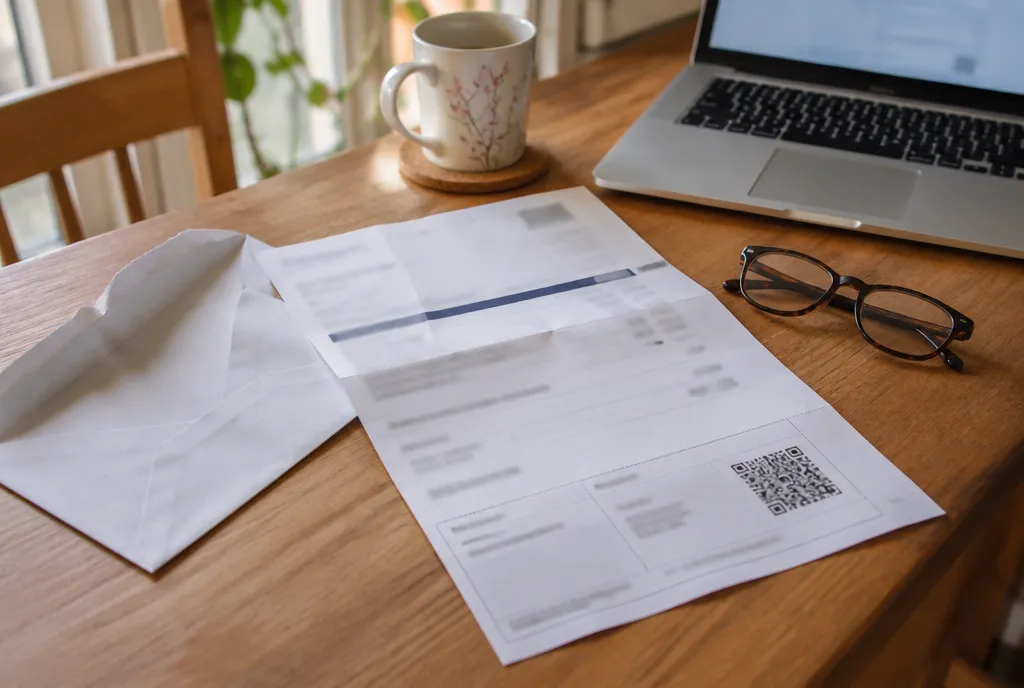
Serafe does not bill everyone in January. Each household is placed at random in one of twelve billing groups, so your annual invoice can come in any month and covers the following twelve months. It shows the names of all adults in the household, the billing period and a QR payment slip.
When the fee last fell, in 2021, Serafe already reduced invoices pro rata for the months in the new year. If your annual invoice runs past 1 January 2027, check the period and amount printed on it. Wrong names, a wrong address or the wrong people grouped together come from the residents’ register: report them to your Kreisbüro first.
5. Pay the invoice — QR bill, eBill or direct debit
💳 QR payment slip, eBill, LSV+ (bank) or Debit Direct (PostFinance) · ⏱️ pay by the due date on the invoice · payment options (Serafe)
The simplest way is to scan the QR code on the payment slip in your banking app. For no paperwork at all, sign up for eBill in your e-banking; Serafe identifies you by the invoice number (format RF-XXXX-XXXX-XXX), so your name in the bank must match the register. Direct debit works through LSV+ for banks and Debit Direct for PostFinance.
If you do not have a Swiss account yet, our bank account guide compares the options. Serafe can also send the invoice by email instead of post; you can set that, the language and the contact person through the QR code above the payment slip.
6. Switch to quarterly invoices — CHF 2 extra on paper
🔁 change via the QR code on your invoice (valid 60 days) or the contact form · 🎟️ CHF 83.75 per quarter in 2026 · ➕ CHF 2 per paper invoice, free by eBill, email or direct debit · quarterly invoices (Serafe)
The annual bill is the default, but any adult in the household can switch to four invoices a year at any time. Scan the QR code on the invoice, which opens a form where you change the payment interval; the code works for 60 days after the invoice date (30 days on a quarterly invoice).
On paper, each quarterly invoice costs CHF 2 more, so CHF 85.75 instead of CHF 83.75 in 2026, or CHF 8 extra a year. Pay by eBill, direct debit or have it emailed and the surcharge disappears. Serafe also grants instalments on request.
7. Shared flats, couples and collective households — who splits what
👥 one fee per flat, however many adults · 🏥 care homes, student residences, hospitals: the institution pays double · 🧑🤝🧑 sharing the cost is a private matter · collective households (BAKOM, in German)
In a shared flat (WG) one invoice covers everyone registered there, so four flatmates pay one fee together and usually split it, about CHF 84 each in 2026. If you are hunting for a room, our guide to finding a flat in Zürich explains WGs and sublets. Couples living together also pay once.
Collective households, such as care homes, student residences, hospitals and prisons, pay double the private fee, and the operator pays it. Someone whose main residence is a care home therefore pays no fee of their own.
8. Exemption for people on EL — supplementary benefits to AHV/IV
✅ annual Ergänzungsleistungen (EL) to AHV or IV · 📄 send Serafe a copy of the legally valid EL decision; that counts as the application · ↩️ backdated up to 5 years · EL exemption (Serafe)
If anyone in your household receives annual supplementary benefits (EL) to the old-age or disability pension, the whole household can be exempted. The exemption is not automatic: send Serafe a copy of the confirmed EL decision. It applies back to the start of the EL, for at most five years.
Social assistance (Sozialhilfe) does not give an exemption, because the fee is already part of the basic allowance. For the pension system itself, see our AHV number guide.
9. Exemption for deaf-blind people — with a form
✅ deaf-blind people, if no one liable to pay lives in the household · 📄 apply with Serafe’s form · ⚠️ report at once if a liable person moves in · deaf-blind households (Serafe)
A deaf-blind person pays no fee as long as no other liable adult lives in the household. The exemption needs Serafe’s application form, available in the downloads section of serafe.ch. If someone who has to pay moves in, the household must tell Serafe in writing straight away.
10. Exemption for diplomats — automatic via the FDFA
✅ holders of an FDFA legitimation card · 🔄 automatic, no application · diplomat households (Serafe)
Staff of embassies, missions and international organisations with an FDFA legitimation card are exempt. The Federal Department of Foreign Affairs sends the data to Serafe directly, so you do not apply. If an invoice arrives anyway, contact Serafe or your organisation’s protocol office.
11. Moving within Zürich or leaving Switzerland — tell the city, not Serafe
📍 report every move to the Kreisbüro or online (eUmzug) · ↩️ leaving Switzerland: refund for months already paid · 🏦 send Serafe your bank details · moves and deregistration (City of Zürich)
Serafe works only with register data, so you never report a move to Serafe. Report it to the city instead, in person or online, and the next invoice follows your new address. If two households merge, for example when you move in with a partner, the old household ends on the last day of the month in which everyone left it.
When you move abroad, deregister at the Kreisbüro before you go. The city reports the departure, and Serafe refunds the months you have already paid once you send it your bank details. A long trip abroad while you keep your Swiss address does not count. Our removal companies in Zürich and the recycling guide help with the move itself.
12. When someone dies — refund for the heirs
🗓️ the household ends on the last day of the month of death · ↩️ refund if the person lived alone and had paid the annual invoice · 📄 send Serafe the certificate of inheritance and bank details · Serafe FAQ
If the deceased was the only adult in the household and had already paid the twelve-month invoice, the heirs get back the amount for the months after death. Send Serafe the certificate of inheritance (Erbschein) and the bank account for the refund. If other adults still live in the flat, the household continues and nothing is refunded.
13. Late payment, reminders and debt collection — CHF 5 and CHF 20
⚠️ CHF 5 per reminder · CHF 20 for justified debt collection · 👥 any adult in the household can be pursued · Serafe FAQ
An unpaid invoice leads to a reminder at CHF 5 each. If that does not help, Serafe starts debt collection (Betreibung) against any adult in the household, with a CHF 20 fee. A Betreibung appears in the debt register, which landlords check, so it can hurt a flat application.
A reminder after you paid usually means a wrong reference number, a payment that was too low, or post that crossed. Check your bank transfer before calling Serafe on 058 201 31 67.
14. Companies pay through the ESTV — turnover CHF 500,000+ (CHF 1.2 million from 2027)
🏢 VAT-registered companies only · 🎟️ fee depends on worldwide turnover · 📈 threshold CHF 500,000 in 2026, CHF 1.2 million from 1 Jan 2027 · 🧾 annual invoice from the ESTV · company fee tariffs (ESTV)
Companies do not deal with Serafe. The Federal Tax Administration (ESTV) bills the company fee once a year, and only VAT-registered firms with worldwide turnover of at least CHF 500,000 pay. From 1 January 2027 the threshold rises to CHF 1.2 million and the two lowest tariff levels go, so around 65,000 more firms pay nothing and only about one VAT-registered company in five still pays.
A new tariff with 60 turnover levels is planned from 1 January 2028 (consultation until 27 October 2026). Sole traders pay the household fee at home and the company fee only if their business crosses the threshold. If you are setting up on your own, our taxes in Zürich guide covers the tax side; for your exact case, ask the ESTV.
The 2026 vote: why the fee did not drop to CHF 200
On 8 March 2026, Swiss voters decided on the initiative “200 Franken sind genug!” (the SRG or “halving” initiative). It wanted to cap the household fee at CHF 200 and abolish the company fee. About 62 percent voted no, and the cantons rejected it as well (official results, Federal Chancellery).
The Federal Council’s counter-plan, decided in June 2024, now applies: CHF 312 from 2027, CHF 300 from 2029, and fewer companies paying. Some unions have asked the government to drop the cut, so check serafe.ch if you read different figures later.
Scam letters and fake invoices: how to spot them
Fake Serafe emails and text messages come in waves, and the federal cyber security office regularly warns about them (current warnings, BACS). Serafe states clearly that it never sends emails with links where you enter account or card details, and it never asks for TWINT payments.
- Real emailed invoices are electronically signed, come from a single Serafe billing address and carry exactly one PDF with a QR code. Never open .docx, .exe or zip attachments.
- Real invoices never point to a foreign bank account or ask you to pay to a new IBAN.
- Refund messages (“you paid twice, click to get CHF 335 back”) are a classic trick. Real refunds only follow a move abroad, a death or an exemption, and Serafe asks for bank details in writing.
- When in doubt, compare the invoice number and amount with your last paper bill, or call Serafe on 058 201 31 67. Do not use phone numbers or links from the suspicious message.
Common mistakes
- Ignoring the bill because you have no TV. The fee does not depend on devices, and reminders cost CHF 5 each.
- Writing to Serafe about a move. Only the city’s register counts; report moves to the Kreisbüro.
- Expecting an automatic EL exemption. You must send the EL decision yourself.
- Paying quarterly on paper. It costs CHF 8 a year more than eBill or email.
- Leaving without deregistering. You lose the refund and the invoices keep coming.
The fee is one of many fixed costs in the city; our page on whether Zürich is expensive puts it next to rent, health insurance and transport.
FAQ
How much is Serafe per year?
CHF 335 per household in 2026, CHF 312 from 1 January 2027 and CHF 300 from 2029. Collective households pay double.
Do I have to pay Serafe if I don’t have a TV?
Yes. Since 2019 the fee is charged per household, regardless of devices or what you watch.
Do I need to register with Serafe?
No. Serafe gets your household from the residents’ register after you register with the city, and the invoice comes automatically.
Why are several names on my Serafe invoice?
All adults registered in the flat are listed, because they are jointly liable for the one fee.
Can I get a refund when I leave Switzerland?
Yes, for the months already paid after you deregister. Send Serafe your bank details once the city has reported your departure.
Can I pay Serafe in instalments?
Yes: switch to quarterly invoices, or ask Serafe for a payment plan if a large back-bill arrives.
Keep planning
- Moving to Zürich: the complete checklist
- Kreisbüro Zürich: registering and reporting moves
- AHV number: where to find it and how it works
- Exchanging your driving licence in Zürich
- Half Fare travelcard and GA: prices and break-even
- Health insurance in Zürich
- Getting around Zürich: tickets and zones
- Swiss German phrases for everyday life
📬 The ZurichGuru newsletter
Once a week: the best events, new places and what is changing in Zürich. Free, unsubscribe any time.