'/%3E%3C/svg%3E) EN
 DE
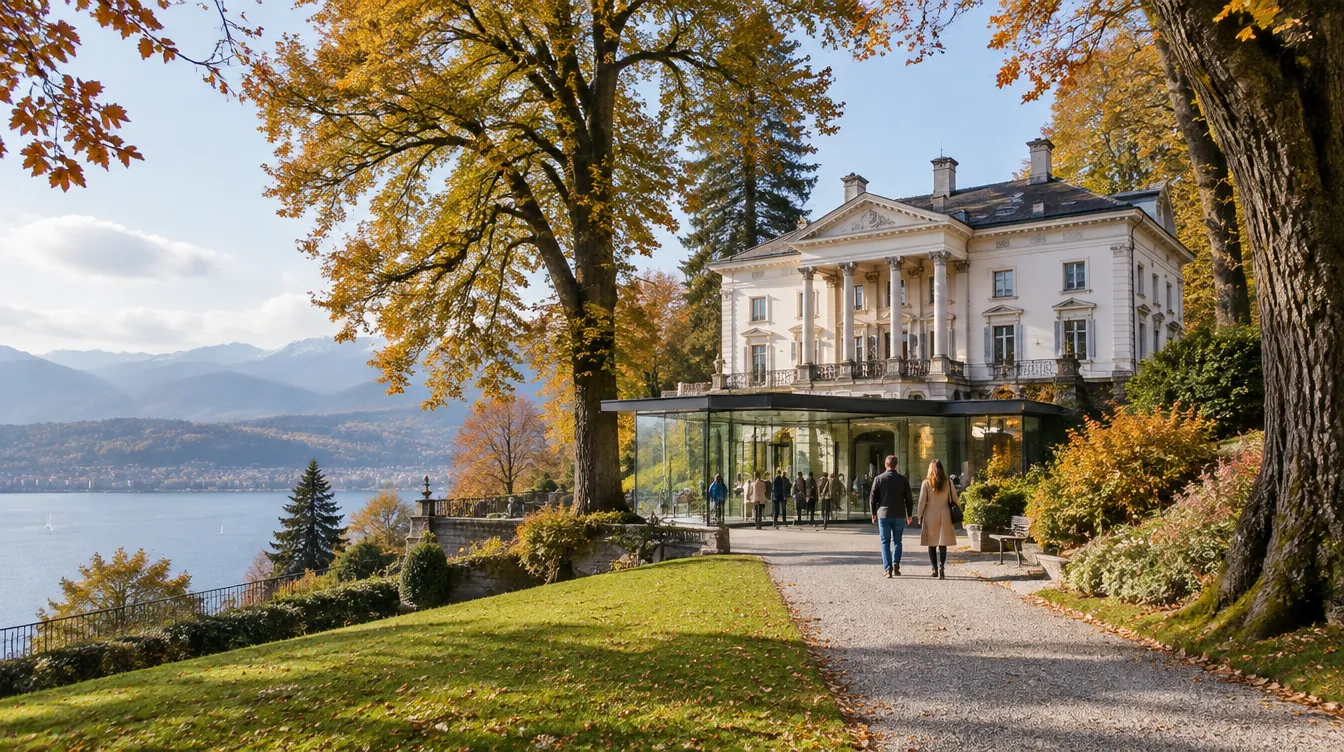
Museum Rietberg is Zürich’s museum of world art, and the only museum in Switzerland devoted entirely to the art of Asia, Africa, the Americas and Oceania. It sits in the Rieterpark above the lake, spread over three 19th-century villas and an underground gallery that you enter through a glass pavilion called the Emerald. Expect Indian bronzes and miniature paintings, Chinese porcelain, Himalayan Buddhist art and African masks, three strong exhibitions this winter, a café in an old greenhouse and a park that is worth the trip on its own. It is one of the calmest of the big Zürich museums, and free for anyone up to 15. We checked every time, price and route below on the museum’s official site in November 2026.
📍 Gablerstrasse 15, 8002 Zürich · 🕐 Tue–Sun 10–17, Thu 10–20, closed Mon · 🎟️ collections CHF 14, special exhibitions CHF 18, free up to age 15 · official website
Why visit Museum Rietberg
Most visitors to Zürich head for the Kunsthaus and the Landesmuseum and never make it up the hill to Enge. That is their loss. Museum Rietberg is run by the City of Zürich and counts among the largest art museums in Switzerland, with some 32,600 objects and 49,000 photographs, and much of the collection is on show either in the galleries or in an open storeroom. The idea behind it, “ars una” (there is only one art), means that a Chinese vase, an Indian painting and a mask from Cameroon are shown with the same care as any European masterpiece.
The setting makes the visit. You walk through a landscaped park with old trees and views over the lake, between villas where Richard Wagner once lived next door, and the museum is rarely crowded. Thursday evenings, when it stays open until 20:00, are especially peaceful.
The villas, Wagner and the Emerald
The museum’s main building is the neoclassical Villa Wesendonck, built for Otto Wesendonck and his wife Mathilde, who moved in in 1857. They lent the half-timbered house next door, Villa Schönberg, to Richard Wagner and his wife Minna. Wagner called it his “asylum on the green hill”; here he wrote the libretto of Tristan und Isolde and set five of Mathilde’s poems to music, the Wesendonck Lieder, before leaving in August 1858. The third villa, the Park-Villa Rieter, shows displays from the collection, and the park and the museum are named after the Rieter family, who owned the estate from 1872 to 1945.
Zürich’s voters approved the museum in 1949, and it opened in 1952 to house the collection of Baron Eduard von der Heydt. In 2007 the architects Alfred Grazioli and Adolf Krischanitz added a large underground extension, crowned by the glass pavilion known as the Emerald (Smaragd). Today you enter through the Emerald and go down two levels into the galleries, which connect to Villa Wesendonck.
What to see in the Museum Rietberg collection
The collection is grouped by region, and a few names keep coming up on the museum’s own pages:
- India: a 10th-century dancing Shiva, one of the museum’s best-known pieces, and a world-famous collection of Pahari painting, the miniatures from the hill kingdoms of northern India, partly from the Alice Boner Collection.
- China: fine porcelain and ceramics from the Meiyintang Collection.
- The Himalayas: Buddhist sculpture and painting from the Berti Aschmann Collection.
- Africa: carved masks and figures, including a 19th-century wooden Batcham mask from Cameroon.
- Japan, the Americas and Oceania: smaller but excellent displays, and a Japanese tearoom, Isshin-an, where the museum holds tea ceremonies on set dates.
Take your time: the rooms are calm, well lit and rarely busy, and photos without flash are allowed.

Current exhibitions at Museum Rietberg (winter 2026/27)
- Red – Masterpieces of Chinese Lacquerware – until 31 January 2027. Carved and painted red lacquer, shown with the LWL Museum in Münster.
- Amazonian Legacies – Art and Archaeology – until 14 March 2027. The ancient art of the Amazon, with a virtual journey to the rock paintings of Chiribiquete and Serranía de La Lindosa in Colombia.
- Nikka – The Indian Painter – until 30 May 2027. The Pahari painter Nikka of Guler (1745–1833), son of the famous Nainsukh.
No further exhibitions had been announced when we checked; see the exhibitions page for updates.
Museum Rietberg tickets and prices
- Collections (including Park-Villa Rieter): CHF 14, reduced CHF 12
- Special exhibitions (Red, Amazonian Legacies, Nikka): CHF 18, reduced CHF 14
- Reduced: AHV/IV, students and apprentices, visitors with a disability (carer free)
- Free: children and teenagers up to and including 15
Entry is free with the Zürich Card and the Swiss Museum Pass, and with KulturLegi. There is no free day or free evening for everyone. Tickets are sold at the desk and in the online ticket shop.
Tours: public tours run on Thursday at 18:30, Friday at 12:15, Saturday at 14:00 and Sunday at 11:00 (CHF 5 on top of entry, tickets at the desk on the day). There is a tour in English every first Thursday of the month. The museum does not offer an audio guide.
Opening hours
- Tuesday, Wednesday, Friday–Sunday: 10:00–17:00
- Thursday: 10:00–20:00
- Monday: closed
- 24 and 25 December: closed
- 26 and 31 December, 1 and 2 January: 10:00–17:00
The Rieterpark is open at all times, even when the museum is closed.
How to get to Museum Rietberg
- Tram 7 (towards Wollishofen) to Museum Rietberg, then a five-minute walk uphill.
- S-Bahn to Zürich Enge, then a ten-minute walk.
- Bus 72 (towards Morgental) to Hügelstrasse, then a six-minute walk.
There is no public car park; disabled parking is next to the coach house, reached via Gablerstrasse. All buildings are wheelchair accessible apart from the atelier and the tearoom, with lifts in the Emerald, Villa Wesendonck and Park-Villa Rieter, and wheelchairs to borrow. Rucksacks, umbrellas and bags bigger than about 20 × 30 cm go in the free lockers. Tickets and zones are explained in our guide to getting around Zürich.
Museum Rietberg with kids
Children and teenagers up to 15 go free, and the museum has a good family programme. The Open Workshop runs every Sunday from 11:00 to 16:00 (last entry 14:00) in the atelier in the coach house: CHF 20, or CHF 15 reduced, for ages 5 and up with an adult, no booking needed. Discovery booklets for children from 8 cost CHF 5 at the desk, and the monthly “Mach mit!” sessions are aimed at children from 3. Strollers are limited in the galleries, but the museum has buggies and baby carriers to borrow. And when attention runs out, the park is right outside. For more ideas, see the family tips in our guide to the best museums in Zürich.
Café, shop and the Rieterpark
The self-service café is in the former greenhouse of Villa Wesendonck, the same one that appears in Wagner’s Wesendonck Lieder. It uses local ingredients, sometimes cooks dishes inspired by the exhibitions, has seats in the courtyard in mild weather and takes no reservations; it follows the museum’s opening hours. In summer you can order a picnic basket for two (CHF 85, at least three days ahead) and spread out in the park. The museum shop sells catalogues, posters and hand-made and Fairtrade goods.
The Rieterpark itself is one of the finest parks in Zürich: big old trees, lawns sloping towards the lake and views over the lake.
What to combine with Museum Rietberg
The FIFA Museum is right by Zürich Enge station, a ten-minute walk downhill, which makes a good world-art-and-football day. From Enge the S8 and S24 continue to Kilchberg and the Lindt Home of Chocolate. Or walk down to the lake for the promenade and lunch at one of the lakeside restaurants in Zürich. For more viewpoints like the Rieterpark, see our guide to the best views in Zürich.
Museum Rietberg: FAQ
How much is Museum Rietberg?
CHF 14 for the collections and CHF 18 for the special exhibitions (CHF 12 and 14 reduced). Under-16s, Zürich Card and Swiss Museum Pass holders get in free.
Is there a free day at Museum Rietberg?
No. There is no free day or evening for everyone, but children up to 15 are always free, and the park is free and open at all times.
How do I get to Museum Rietberg?
Take tram 7 to Museum Rietberg and walk five minutes uphill, or the S-Bahn to Zürich Enge and walk ten minutes.
How long should I plan?
Allow two hours for the collection and one exhibition, and longer if you add the café and a walk in the park.
What is the Wagner connection?
Richard Wagner lived in Villa Schönberg, next to Villa Wesendonck, in 1857–58 and worked on Tristan und Isolde there.
More museums in Zürich
Museum Rietberg is the most beautiful museum setting in Zürich and a calm alternative to the busier houses in town. For the rest, see our guide to the best museums in Zürich and the visitor guides to the Kunsthaus Zürich, the Landesmuseum Zürich and the Museum für Gestaltung, or browse all places in Zürich.
📬 The ZurichGuru newsletter
Once a week: the best events, new places and what is changing in Zürich. Free, unsubscribe any time.