'/%3E%3C/svg%3E) EN
 DE
The Natural History Museum Zürich (Naturhistorisches Museum der Universität Zürich, NMZ) is the city’s best free museum and a guaranteed hit with children. Opened in March 2024 in the University of Zürich’s main building, it brings the old Zoological and Paleontological Museums together under one roof: a 17-metre Diplodocus in the central hall, more than 1,500 animal specimens, world-famous marine reptile fossils from the UNESCO site of Monte San Giorgio and a Neanderthal who comes to life on screen. Entry is free, it opens six days a week, and on Thursday evenings it stays open late for adults. We checked every time and date below on the museum’s official site in November 2026.
📍 Karl-Schmid-Strasse 4, 8006 Zürich · 🕐 Tue–Sun 10–17, Thu also 17:30–20 (adults), closed Mon · 🎟️ free entry · official website
Why visit the Natural History Museum Zürich
Very few museums in Switzerland let you stand under a full dinosaur skeleton without paying a franc. Here you can, and the collection behind it is serious science: the University of Zürich has studied and prepared these fossils for a century, and its researchers still run the Sunday tours. The texts are short and simple, so the museum works for curious adults as well as for six-year-olds.
It is also compact. You can see the highlights in an hour and a half, which makes it easy to slot into a day on the university hill together with the Polyterrasse view, the Kunsthaus or a walk down into the Old Town. The museum’s own tip is a good one: come on a sunny day, because on rainy days, especially at weekends, it fills up with families.
The museum and the UZH main building
The Natural History Museum of the University of Zurich was created in 2024 by merging four university collections: the Zoological, Paleontological, Anthropological and Botanical Museums. The opening on 18 March 2024 combined the animal and fossil halls and added new star pieces, among them four dinosaur skeletons given to the university by the Sauriermuseum Aathal. Human evolution and plant exhibits were added later, so the museum now covers all four fields.
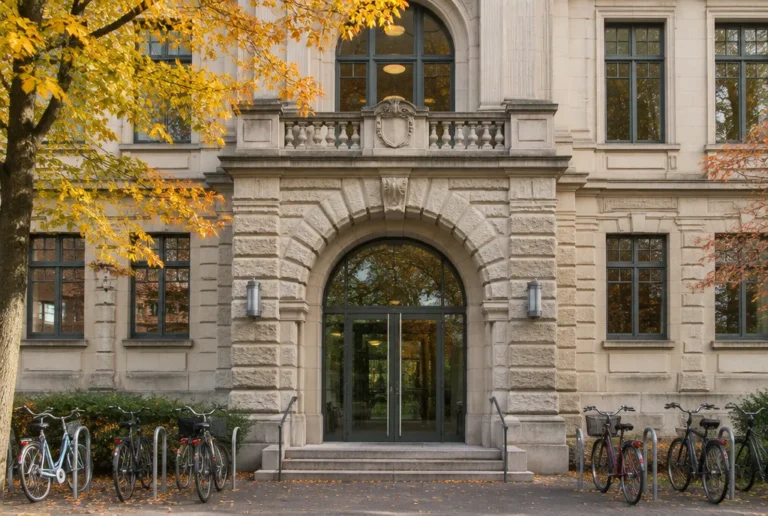
It sits in the ground floor and basement of the university’s main building, designed by the architect Karl Moser and built between 1911 and 1914. Its 65-metre tower was Zürich’s first high-rise and is still a landmark on the skyline above the Old Town. Inside the main building is the Lichthof, a glass-roofed atrium framed by arcades, which you can see on weekdays (the building is open Monday to Friday 07:00–22:00 and Saturday 07:00–13:30). We could not find any regular public access to the tower itself; for the panorama, walk two minutes to the ETH’s Polyterrasse instead.
What to see at the Natural History Museum Zürich
Dinosaurs in the central hall
The life-size Plateosaurus model greets you at the entrance, and you are allowed to touch it. Behind it, a 17-metre Diplodocus stretches through the central hall, with models of its egg and a young animal next to it, and four bronze vertebrae with Braille text that let you feel how big it was. In the “dinosaur jungle”, the predator Allosaurus (“Big Al”) faces the plated Hesperosaurus (“Victoria”), and a small Nanosaurus, about the size of a medium dog, shows that not every dinosaur was a giant. Its life-like reconstruction won the John J. Lanzendorf National Geographic PaleoArt Prize. An oversized magpie skeleton reminds you that birds are living dinosaurs.
Monte San Giorgio and the giant ichthyosaur
The core of the paleontology section is the fossil collection from Monte San Giorgio in southern Ticino, a UNESCO World Heritage Site since July 2003. University teams dug here between 1924 and 1975, and the finds are still prepared and studied in Zürich. About 240 million years ago the site was a shallow sea with oxygen-poor water at the bottom, which is why so many skeletons survived complete: fish of all sizes, paddle-limbed sauropterygians, dolphin-shaped ichthyosaurs and placodonts with shell-crushing teeth.
Near the entrance lies a second record-breaker: an ichthyosaur about 169 million years old, found by UZH researchers in the canton of Aargau. It may have measured up to seven metres, and the university describes it as the largest and most complete fossil of its kind in the world.
The Treasure Vault with 50 masterpieces
At the back of the ground floor, a copper-red room with a soft carpet and dimmed light shows 50 of the most beautiful fossils ever found, presented like works of art rather than in scientific order, among them a strangely coiled ammonite. Nature created them with pressure and minerals over the past 550 million years. They are a permanent loan from the Sauriermuseum Aathal, and the catalogue (German and English) is sold in the shop.
Swiss animals up close
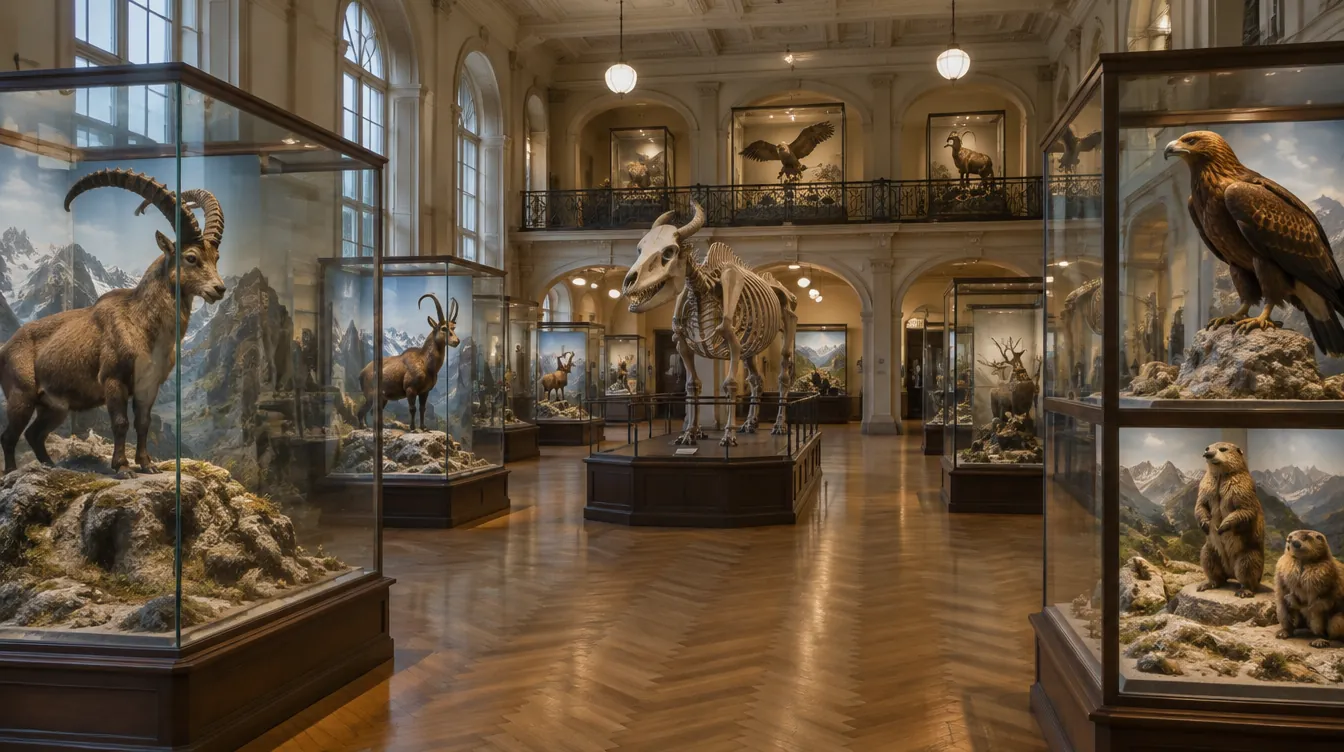
The ground floor holds almost every animal species native to Switzerland except most insects and bats. Mammals, reptiles and amphibians are grouped by how they are related, while the birds sit in the habitats where you would actually meet them. You can listen to their calls at sound stations, which is a nice way to learn which bird you heard on your last hike.
Animals from around the world and walking on two legs
Downstairs, the basement takes you around the globe by zoogeographic region, from the African savannah and Asian rainforest to the Arctic and Antarctic, with a giraffe and a giant tortoise among the big pieces. In the middle, “Bipedalism” lines up kangaroos, penguins, ostriches and our own ancestors, including reconstructions of “Lucy” and Homo erectus. On the heat-sensitive floor you can leave your own glowing footprints.
Ice Age, Neanderthals and talking plants
In “Orsa’s World”, the Neanderthal Orsa comes to life in three short projections (about 6 minutes each, best from age 10) about the Ice Age, his daily life and human kinship. The nearby Ice Age corner shows megafauna such as mammoths, woolly rhinos and cave bears. Next door, “Plants talk too” explains, with flower models and hands-on stations, how plants send signals through roots, scents and colours.

Exhibitions, films and events
There is no special exhibition in November 2026. The museum says it has used its space to expand the permanent exhibition and currently cannot host temporary shows, so everything listed above is what you will see. What changes is the programme, and all of it is free:
- Museum cinema: free nature films twice a day, Tuesday–Saturday at 11:00 and 15:00, Sunday at 11:00 and 16:00. “Humpback whales” runs until 15 November, “Penguins” 17–29 November, a tiger film 1–13 December and “Eagles” 15–30 December (all in German, from age 10).
- Sunday tours: every Sunday at 11:30, about one hour, led by UZH students and researchers, no booking. Coming up: skulls and teeth (8 Nov), dinosaurs (15 Nov) and two-legged animals (29 Nov, from age 9).
- “Wissen to go” on Thursday evenings: short talks for adults at 18:00 from September to May. In November and December 2026 the topics include badgers in the city, wolves and dogs, a talk in English on human-wildlife interactions (26 Nov), an English-language science comedy show (3 Dec) and protecting chimpanzees. Full list on the Wissen to go page (in German).
Opening hours and holiday closures
- Tuesday–Sunday: 10:00–17:00
- Thursday evening: also 17:30–20:00, adults only
- Monday: closed
Over Christmas and New Year the museum closes on 24, 25 and 26 December and on 31 December, 1 and 2 January. In between, it is open as usual on Sunday 27, Tuesday 29 and Wednesday 30 December. It also closes on Sechseläuten and Knabenschiessen Mondays, 1 May and 1 August, as well as on Easter and Whit Monday. Check the official page before a holiday visit, as the museum lists these dates without a year.
Admission
Entry to the Natural History Museum Zürich is free for everyone, with no ticket needed. On the way out there is an “exit pricing” box where you can leave a donation in cash or by TWINT to help keep it that way. The tours, workshops, films and talks are free too. The only paid extra we found was the occasional short tour of the heat-sensitive floor (CHF 5, held on a few dates in autumn 2026), and groups must register online in advance.
Please note: children under 12 may only enter with an adult. For more free days out, see our guide to free and cheap things to do in Zürich.
How to get to the Natural History Museum
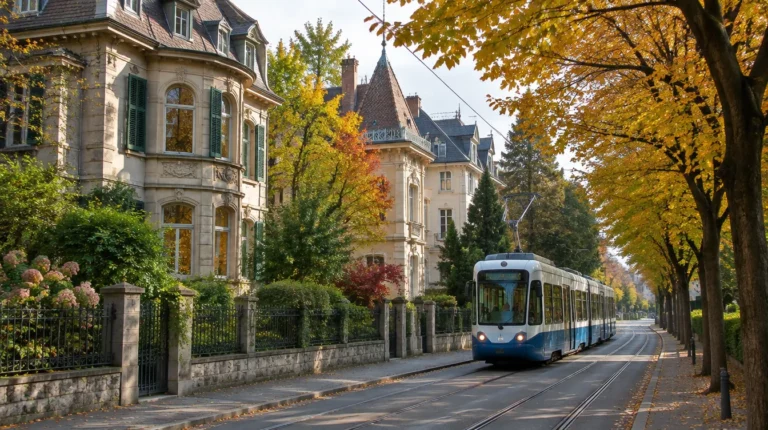
The nearest stop is ETH/Universitätsspital, served by trams 6, 9 and 10; from there it is a three-minute walk to the entrance on Karl-Schmid-Strasse. From Zürich HB, take tram 6 or 10 from Bahnhofplatz/HB (about 8–9 minutes including the walk to the stop). Tram 9 comes from Bellevue in about 5 minutes, and tram 10 runs direct from the airport in about half an hour. Because of the Bahnhofquai construction, several tram lines run on changed routes until 12 December 2026; trams 6 and 10 currently leave from the Bahnhofplatz/HB stop.
The most fun way up is the Polybahn, the little red funicular from Central to the Polyterrasse (under two minutes, ZVV tickets valid). From the top it is about five minutes on foot past the ETH main building. On foot from Zürich HB, allow around 15 minutes, uphill. Parking is very limited, so leave the car behind.
The entrance is step-free and almost every area is wheelchair accessible, with a lift to both floors and an accessible toilet (ask for the key at reception). Folding stools and the Hidden Disabilities Sunflower lanyard are available at the desk.
The Natural History Museum Zürich with kids
This is one of the best places in Zürich for children, and it costs nothing. Borrow a free interactive museum bag at reception (no booking): there are bags for children up to second grade and a tactile dinosaur bag for visitors with visual impairments. Younger kids can follow “Clara the little magpie” and her picture book through the dinosaur hall, and printable quizzes are on the museum’s website.
On Sundays at 14:00 and 15:00 there are free family workshops (about an hour, from age 5, no booking). In November and December 2026 the theme is the seasons from an animal’s point of view, with the sessions on 22 November and 13 December held in English. Over past Christmas holidays the museum has run a free holiday quiz with stickers and a small reward for finding all the animals; ask at the desk. Remember that under-12s need an adult with them, and the Thursday evening slot is for adults only.
Food, shop and practical tips
There is no café inside: food and drink stay outside the museum. On weekdays the ETH’s Mensa Polyterrasse next door serves lunch to outside guests (main dishes about CHF 14.50–16 in November 2026), and the cafés of Niederdorf in the Old Town are ten minutes downhill. Coats and bags go in the cloakroom by the entrance, and the small shop at the information desk sells books, including the Treasure Vault catalogue.
Plan about 90 minutes for a first visit, two hours if you add a film. Floor plans in English are on the exhibitions page.
What to combine with the museum
Walk two minutes to the Polyterrasse in front of the ETH main building for one of the best free views over the Old Town rooftops and the lake, then ride the Polybahn down to Central. The Kunsthaus Zürich is about ten minutes’ walk down Rämistrasse at Heimplatz, and steps and lanes lead you straight into the Old Town. With children, combine it with the Zoo Zürich: tram 6 runs from the museum’s stop to the zoo in eleven minutes, so you can see the stuffed animals in the morning and the real ones in the afternoon.
Natural History Museum Zürich: FAQ
Is the Natural History Museum Zürich free?
Yes. Entry, films, Sunday tours and family workshops are all free. A donation box at the exit helps keep it that way.
Is the Natural History Museum open on Mondays?
No. It is open Tuesday to Sunday from 10:00 to 17:00, plus Thursday evenings from 17:30 to 20:00 for adults.
Is it open over Christmas?
It closes on 24, 25 and 26 December and on 31 December, 1 and 2 January, but is open on the other days in between except Monday.
Is this the old Zoological Museum?
Yes, partly. The Zoological and Paleontological Museums of the University of Zürich, plus its anthropology and botany collections, merged into the Natural History Museum in 2024, at the same address on Karl-Schmid-Strasse.
If your children want to go on from fossils to the human body, the hands-on Kulturama museum of human evolution in Hottingen is a short tram ride away.
More museums in Zürich
The Natural History Museum Zürich is the perfect free start for families and fossil fans. Find more ideas in our guide to the best museums in Zürich, see the paintings at the Kunsthaus Zürich, or read about the opening of the museum in the University of Zürich’s announcement.
📬 The ZurichGuru newsletter
Once a week: the best events, new places and what is changing in Zürich. Free, unsubscribe any time.