'/%3E%3C/svg%3E) EN
 DE
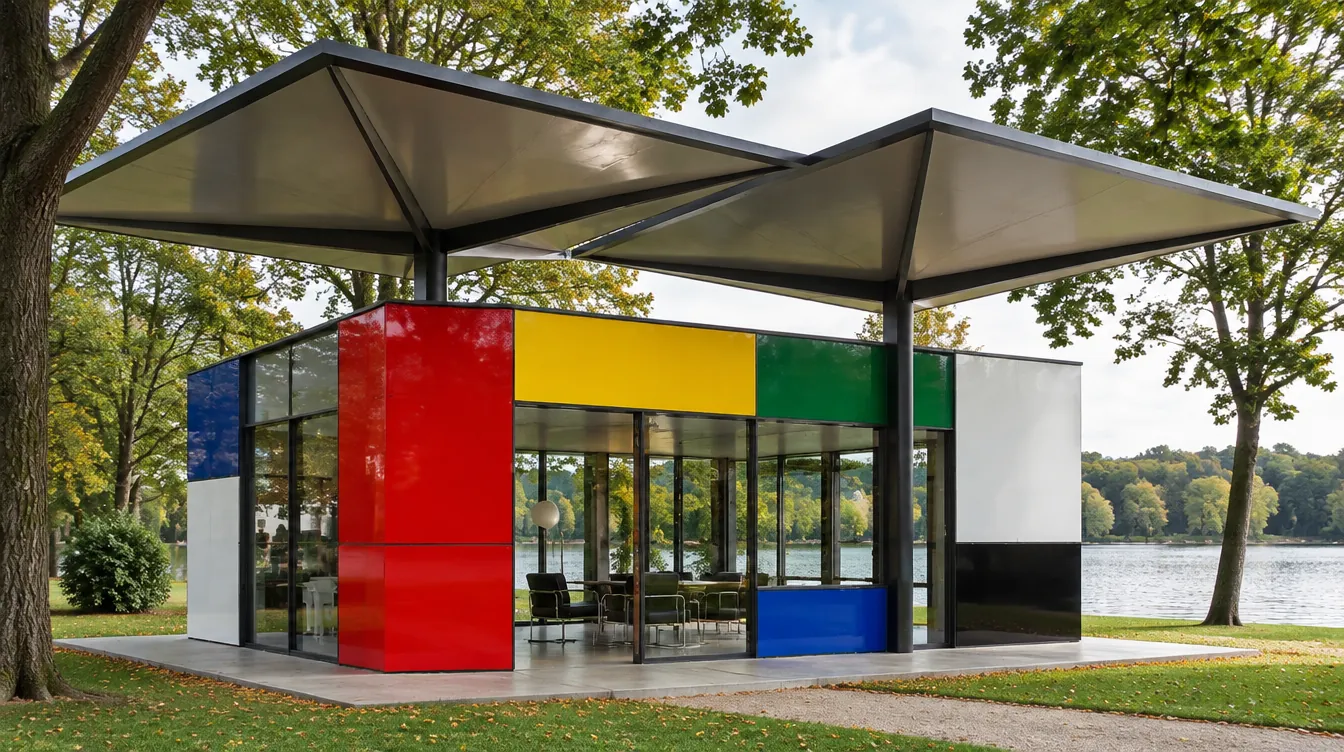
The Pavillon Le Corbusier is the last building designed by the great Swiss-French architect, and his only one made of steel and glass. It stands in a park by Lake Zürich at the Zürichhorn, a colourful, ship-like house that looks almost weightless, and since 2019 it has been run as a museum by the Museum für Gestaltung Zürich. The 2026 season ends on 29 November 2026, and the pavilion stays closed through the winter until spring 2027. Below is everything you need for a visit, checked on the official sites in November 2026.
📍 Höschgasse 8, 8008 Zürich (Seefeld) · 🕒 2026 season until 29 November: Tue–Sun 12:00–18:00, Thu until 20:00, closed Mon · 🎟️ CHF 15, reduced CHF 10, under 20 free, free on Thursdays from 17:00 · 🚆 tram 11 or 15 to Höschgasse, about 10–17 minutes from Zürich HB · official website
Pavillon Le Corbusier opening season: closed in winter
The Pavillon Le Corbusier is a summer museum. The 2026 season runs from 17 April to 29 November 2026, Tuesday to Sunday 12:00–18:00, on Thursdays until 20:00, closed on Mondays. From December to April it is closed, including all the Christmas and New Year holidays and Easter 2027. You can look at the building from the outside at any time.
When does it reopen? The exact opening date of the 2027 season has not been published yet. Last year the season started on 17 April. The museum’s holiday calendar already lists the Pavillon as closed on Sechseläuten (19 April 2027) and open on Ascension Day, 6 May 2027, 12:00–18:00, so expect it to reopen in late April or early May 2027. Check the official website before you plan a spring visit. If you are in Zürich before 29 November 2026, go now.
History: Heidi Weber and Le Corbusier’s last building
The pavilion exists thanks to one determined woman. Heidi Weber, a Zürich interior designer, gallery owner and patron, persuaded Le Corbusier to design a museum building for her in 1960. She paid for it with her own money, as a single mother, and saw it through despite many difficulties. The building plans were submitted in 1961.
Le Corbusier (1887–1965) died before it was finished. Heidi Weber opened it on 15 July 1967 as the Centre Le Corbusier – Heidi Weber Museum and ran it as director and curator for 50 years. Since 2019 the City of Zürich has had it run by the Museum für Gestaltung Zürich, under the name Pavillon Le Corbusier. A 1967 film by Fredi Murer and Jürg Gasser shows how it was built between 1965 and 1967; it is linked on the museum’s history page.
1. The building from outside — steel, glass and colour
📍 Höschgasse 8, in the park between Seefeldquai and the Zürichhorn · 🕒 visible from outside any time, all year · 🎟️ free from outside · official history and architecture page
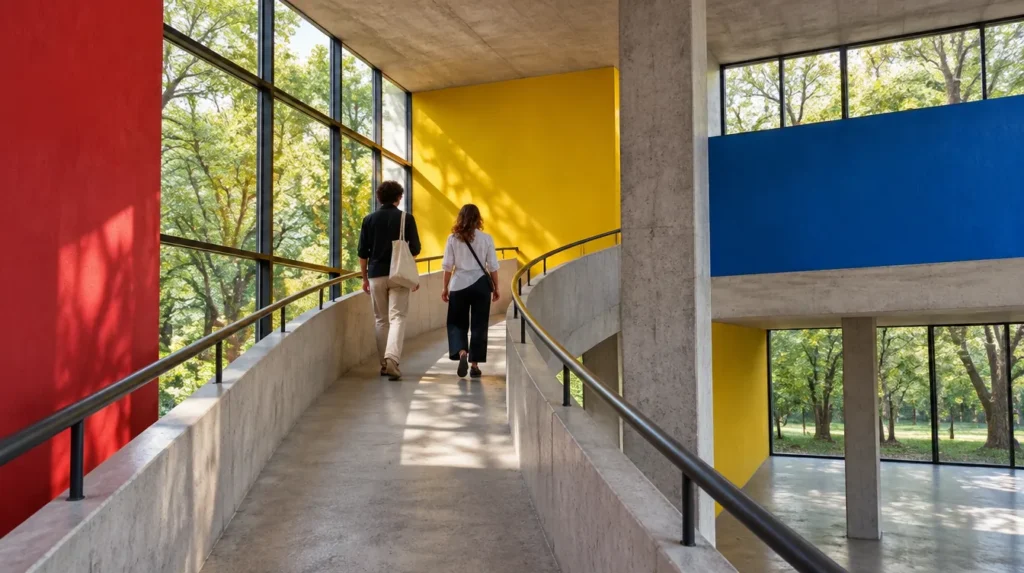
Start by walking all the way round. Le Corbusier designed the pavilion from the start as the ideal exhibition building, a “synthesis of the arts” where art, architecture and life merge. Its proportions follow his Modulor proportion system, and it is put together from prefabricated, recurring elements in steel and glass, finished in bold colours. The result looks light and filigree, almost like a model.
In winter, when the museum is closed, this is still worth the walk: the colours look great against grey lake light, and the park is quiet. The museum describes the building as “ship-like”, which makes sense once you see it next to the water.
2. The promenade architecturale — walking through the house
📍 inside the pavilion, all floors · 🕒 during the season, Tue–Sun 12:00–18:00, Thu until 20:00 · 🎟️ included in admission · official website
Le Corbusier believed you can only understand a building by moving through it. He called this the “promenade architecturale”: a carefully planned route that stages the architecture for you. Inside the pavilion you follow it up the access ramp and across the different floors, and the views, the light and the spaces change at every turn.
Take your time and do it slowly. The museum’s own children’s trail sums it up well: the pavilion cannot be understood from one spot, only on the move.
3. The roof terrace — the small roof garden
📍 top of the pavilion · 🕒 during the season · 🎟️ included in admission · official website (accessibility)
The small roof garden is one of the recurring elements Le Corbusier used in his buildings, along with the access ramp and the promenade itself. Up here you step outside again, with the trees of the park and the lake around you, and see the building’s colours and steel frame up close.
Note that the roof terrace is not accessible for people with mobility impairments.
4. The annual exhibition — The Architecture of Power (until 29 November 2026)
📍 inside the pavilion · 📅 17 April to 29 November 2026 · 🎟️ included in admission · official exhibition page
Every year the pavilion shows a new exhibition on one side of Le Corbusier’s work. He was not only an architect and urban planner but also a painter, sculptor and furniture designer. The 2026 show, “The Architecture of Power”, looks at how monumental buildings stage political power, based on his urban visions and designs, and at how he repeatedly failed to keep a critical distance from fascism in his search for big commissions.
It is a thoughtful, sometimes uncomfortable exhibition, and it ends on 29 November 2026. The 2027 exhibition has not been announced yet.
5. Guided tours — Sunday tours in German and English
📍 meet at the pavilion · 📅 Sundays during the season, for example 15 November 2026 at 14:00 (German) and 15:00 (English), and 22 November at 14:00 (German) · 🎟️ included in admission; registration recommended · official calendar
A one-hour guided tour takes you through the building and the current exhibition. The Sunday tours cost nothing extra on top of your ticket and are limited to a small group, so register online in the calendar; people who just turn up are welcome if there is space.
Groups can also book a private tour or a self-guided group visit through the museum.
6. The digital guide — 18 stations on your phone
📍 on your own phone, inside and around the pavilion · 🎟️ free to use · official digital guide
The museum’s free audio tour explains the facts and background of the building, and its place in Le Corbusier’s work, in 18 stations. Bring headphones. It is the best way to visit if there is no guided tour on your day.
7. Hands-on table and Ma Promenade — for kids and creative adults
📍 inside the pavilion · 🎟️ included in admission · 👧 Ma Promenade from age 9, children under 12 with an adult · official Ma Promenade page
At the hands-on table, anyone can design new colour schemes for the pavilion or make photo collages of modernist city spaces. “Ma Promenade” is an architecture trail with activity sheets for young people from 9, available at the hands-on table or the cash desk. It turns the visit into a small treasure hunt through the building.
Children of pre-school age must be supervised by an adult at all times, and baby carriages are not allowed inside because space is tight.
8. Free Thursday evenings — admission free from 17:00
📍 Höschgasse 8 · 🕒 Thursdays 17:00–20:00 during the season · 🎟️ free for everyone · official admission page
On Thursdays the pavilion stays open until 20:00, and from 17:00 entry is free for everyone. In autumn that means you see the building as the light fades and the lamps come on inside, which is a very different experience from a bright afternoon. The last free Thursday of the 2026 season is 26 November.
9. The combined ticket — all three Museum für Gestaltung sites
📍 Pavillon Le Corbusier, Ausstellungsstrasse and Toni-Areal · 🎟️ combined ticket CHF 20, reduced CHF 15; annual pass CHF 60 / 35 · official admission page
The Museum für Gestaltung Zürich has three locations: the Pavillon, the main building on Ausstellungsstrasse near the main station and the Toni-Areal in Zürich West. A combined ticket for all three costs CHF 20 (reduced CHF 15), only CHF 5 more than a single entry. The two other sites stay open in winter, so you can use them after the pavilion closes. Our guide to the Museum für Gestaltung Zürich covers both.
10. Chinagarten — the Chinese garden next door
📍 Bellerivestrasse 138, 8008 Zürich, two minutes from the pavilion · 🕒 daily, November–April 11:00–17:00, May–October 11:00–19:00 · 🎟️ free · 🚌 bus 912 or 916 to Chinagarten · official website (City of Zürich)
A small walled Chinese garden with a red gate, golden roofs and a pond, given to Zürich by its partner city Kunming and opened in 1994. It is open every day of the year and free, which makes it the perfect partner for a winter walk past the closed pavilion. Allow 30 to 45 minutes. The full story is in our Chinagarten Zürich guide.
11. Heureka by Jean Tinguely — the clanking machine sculpture
📍 Zürichhorn park, by the lake, next to the pavilion · 🕒 in motion from 1 April to 15 October, daily at 11:00, 15:00 and 19:00 for about 8 minutes · 🎟️ free · official info (Zürich Tourism)
Jean Tinguely built this huge kinetic sculpture out of iron bars, wheels, pans and pipes for the Swiss national exhibition in Lausanne in 1964. It was his first public work and has stood at the Zürichhorn since 1967, the same year the pavilion opened. In summer it rattles into life three times a day; in winter it stands still, but it is still worth a look.
12. Zürichhorn and the lake promenade — the walk there
📍 from Bellevue along Utoquai and Seefeldquai to the Zürichhorn · 🕒 open any time · 🎟️ free · 🚶 about 25–30 minutes on foot from Bellevue · official info (Zürich Tourism)
The nicest way to reach the Pavillon Le Corbusier is on foot along the lake. Start at Bellevue and follow the quays south past the lakeside baths and the old trees until the Zürichhorn park opens up, with big lawns, a playground and views across the water to the Alps on clear days. The restaurants Lake Side and Fischerstube sit right on the shore if you need a coffee.
See our guide to the Lake Zürich promenade for the full walk.
Pavillon Le Corbusier tickets and prices
- Regular: CHF 15. Reduced: CHF 10 (students, apprentices, seniors, groups of 10 or more, IV card holders).
- Free: under 20, everyone on Thursdays from 17:00, and holders of the Swiss Museum Pass, Swiss Travel Pass and Zürich Card, among others.
- Combined ticket for all three museum sites: CHF 20, reduced CHF 15.
- No online tickets: you buy them on site in the shop. Bring ID for any discount.
How to get to the Pavillon Le Corbusier
- Tram: tram 11 or 15 to Höschgasse, then a few minutes on foot towards the lake. From Zürich HB it takes about 10 to 17 minutes.
- Bus: bus 33 or 916 to Höschgasse, or bus 912 or 916 to Chinagarten.
- Train: Zürich Stadelhofen station is a 15-minute walk away.
- Car: the pavilion has no parking spaces, so come by public transport. Our guide to getting around Zürich explains tickets.
Accessibility and practical tips
- Listed building: the pavilion does not meet modern building rules. The lower and upper floors are only partly accessible for wheelchair users, the roof terrace not at all, and there is no accessible toilet. Seating and folding stools are available, and companions enter free.
- No café: there is no food or drink in the pavilion. Use the restaurants at the Zürichhorn.
- Photos: photos for private use are allowed, without flash or tripod.
- Time needed: about one hour for the pavilion, two to three hours with the Chinagarten, Heureka and the lake walk.
- Combine it: more museums are in our list of the best museums in Zürich.
Pavillon Le Corbusier: FAQ
Is the Pavillon Le Corbusier open in winter?
No. It closes after 29 November 2026 and stays closed from December to April. The 2027 reopening date is not published yet; it is likely to be late April or early May 2027. You can see the building from outside all year.
How much does the Pavillon Le Corbusier cost?
CHF 15, reduced CHF 10, free for under-20s and for everyone on Thursdays from 17:00. A combined ticket with the other two Museum für Gestaltung sites costs CHF 20.
Who built the Pavillon Le Corbusier?
Le Corbusier designed it for the Zürich patron Heidi Weber, who commissioned it in 1960 and opened it in 1967, two years after his death. It is his last building and his only one made of steel and glass.
📬 The ZurichGuru newsletter
Once a week: the best events, new places and what is changing in Zürich. Free, unsubscribe any time.